
FreeTextDetector AI Checker: What It Measures and What It Cannot Tell You
How the FreeTextDetector AI Checker scores a draft, the five writing signals behind its number, and the honest limits of a rule-based pattern estimate.
Most people reach for this tool after a draft comes back with a score and no explanation of it.
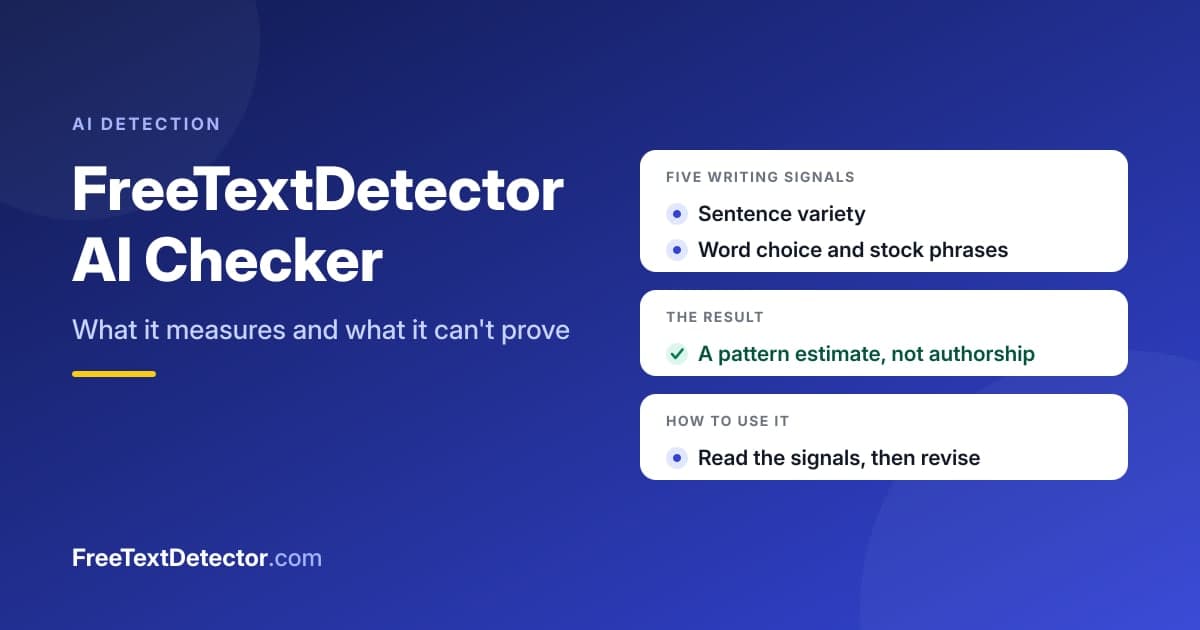
The FreeTextDetector AI Checker is a rule-based pattern estimate, not an authorship test. It scores a draft for five writing habits that AI text often shares, then combines them into a human-like number from 5 to 99. The five are sentence-length variety, word predictability, stock phrases, contractions, and repeated openers. It cannot prove who wrote the text.
The five signals behind the number
Each signal is measured locally with rule-based code and a word-frequency list. No generative model reads your text, and nothing you paste is stored after the result returns. The weights below describe how the score is built; they are not a measure of how often the score is right.
| Signal | Weight | What it measures |
|---|---|---|
| Sentence-length variety | 30% | Whether sentences hold one length or mix short with long |
| Word predictability | 20% | How narrow or wide the spread of word frequency is |
| Stock phrases | 20% | How often AI-favored phrases appear per hundred words |
| Contractions and punctuation | 15% | Whether the text uses them, the way people usually do |
| Repeated openers | 15% | How often consecutive sentences start with the same word |
A draft whose sentences all run the same length loses most of the first signal before a single word is judged. That is why variety carries the largest weight, because uniform rhythm is the habit model output falls into most often. The full method, signal by signal, lives on the AI Text Detector page.
Reading the result without over-reading it
The score sits inside a band. A human-like reading of 85 or more is labelled "Strongly human-like patterns," 65 to 84 "Mostly human-like patterns," 45 to 64 "Mixed patterns," and below 45 "Many AI-like patterns." Under the number the checker lists the signals that moved it, so a low-variety line points at the exact passages to revise.
Read the list first. Those bands are labels for a pattern mix, not grades of authorship, and our guide to reading a detection score sets out what each band can and cannot support.
Why it is an estimate and not proof
These are rules, not a trained classifier, and they have not been validated against a labelled set of human and AI writing. That one fact sets the limit on everything above. Careful, formal human prose can score as AI-like, and an AI draft that has been edited can score as human. Independent tests point the same way, and our write-up on AI text detector accuracy summarizes what those tests found.
So never turn a low reading into an accusation against a student, a writer or an employee. No detector on the market can establish authorship reliably, and this one does not claim to. A result is a reason to look closer at specific sentences, nothing more.
When length changes the reading
Most of the signals need several sentences before they measure anything real. Sentence-length variety cannot exist inside one sentence, and a single stock phrase in a twenty-word passage weighs far more than the same phrase in five hundred words. A one-line paste therefore returns a number that says more about its own length than about its style. For a steadier reading, check two full paragraphs and treat anything under about fifty words as noise rather than signal.
Where the checker fits in your workflow
The same editor can rewrite what it scores. Running the AI humanizer sends the text through the rule-based engine and then scores the original and the rewrite side by side, so you can watch which signals moved and which stayed put. That before-and-after is the useful part, because the score alone is a snapshot while the comparison shows what made the draft read flat.
There is no target number to hit here, and chasing one would undo the point. Revise the passages the signal list names, then check again to see whether the writing got clearer.
Frequently asked questions
Is the FreeTextDetector AI Checker free?
Yes. It needs no account and no card. Each check accepts up to 5,000 characters, and the text is not stored once the result is returned.
Can it tell whether ChatGPT wrote my text?
No. It measures the writing patterns ChatGPT drafts tend to share, and people produce the same patterns in formal or careful prose. The result is a reason to review specific sentences, not a verdict on where they came from.
Why does my own human writing score low?
Formal style is the usual cause. Long sentences of even length, few contractions and a narrow set of connectives are exactly what the five signals flag, whether a person or a model wrote them.
Does editing the text change the score?
Editing usually lifts the human-like reading, because it tends to add rhythm variety and remove stock phrases. Nothing in the checker is tuned against another detector, and no edit should be judged by a number you were trying to reach.
What is the difference between this and a plagiarism checker?
A plagiarism checker matches your wording against published sources, while this checker looks only at writing patterns inside your own text. Our piece on AI plagiarism checker vs AI detector explains when each one matters.
Bottom line
Start by checking two or three paragraphs of a real draft, then read the signal list before you read the score. The list is the part you can act on, and the number is only a summary of it. Treat a low reading as a short revision checklist rather than proof of anything about who wrote the text.