
AI Text Detector Accuracy 2026: What Independent Research Shows
What independent studies found about AI text detector accuracy in 2026, why false positives hit non-native writers, and how to judge a vendor's accuracy claim.
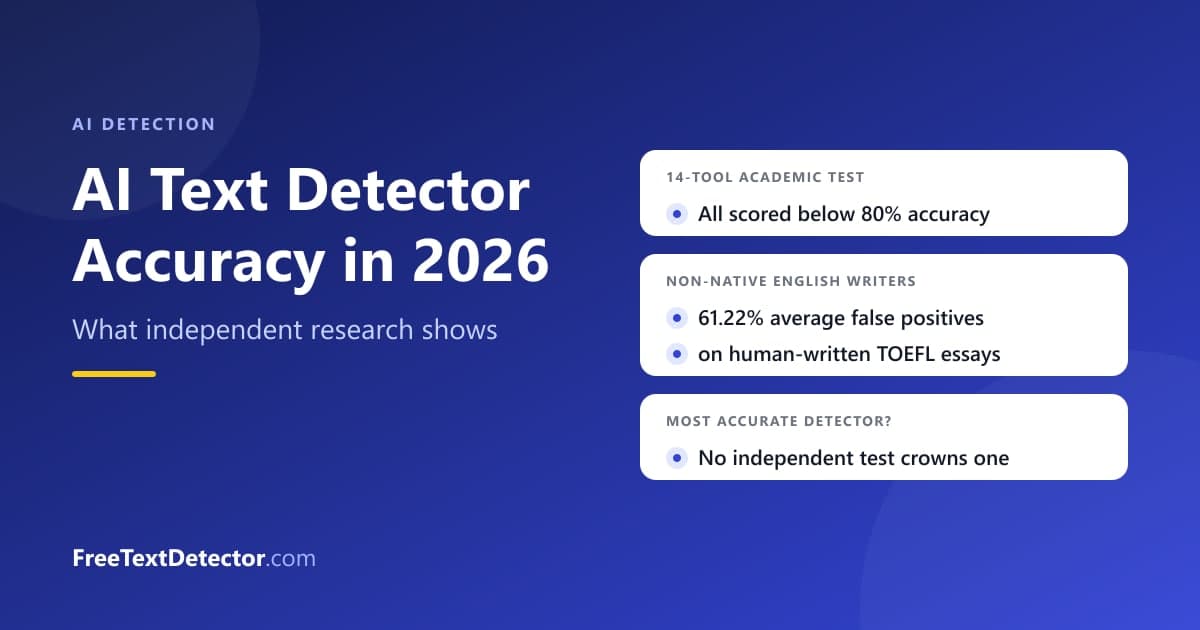
Are AI detectors accurate? Not reliably enough to prove who wrote a text. If you searched for AI text detector accuracy 2026, that is the short answer, and the published independent research backs it up. Peer-reviewed tests have found tools that miss a large share of AI-written text, tools that flag human writing as machine-made, and accuracy that drops sharply once AI text has been edited or paraphrased. Vendors publish much better numbers, but those numbers come from their own test sets and their own thresholds.
AI text detector accuracy 2026: what the research says
Most of the rigorous, independent testing was published between 2023 and 2024. Detectors have been updated since, so no study below tells you how a specific tool performs today. What they show is a pattern of failure that has held across research teams, datasets and years.
A 14-tool test in academic writing
In December 2023, Debora Weber-Wulff and seven co-authors published Testing of detection tools for AI-generated text in the International Journal for Educational Integrity. They tested 12 publicly available tools and two commercial systems, Turnitin and PlagiarismCheck, on 54 test documents whose origin they knew, for a total of 756 tests.
Their conclusion was blunt: the tools "are neither accurate nor reliable." All of them scored below 80% accuracy, and only five scored over 70%. The tools leaned towards calling text human-written, and the authors estimate that about 20% of AI-generated texts would likely be misattributed to humans. Human text that had been machine-translated into English also caused trouble: accuracy on those documents dropped by 20% compared with the original human-written set.
OpenAI withdrew its own classifier
OpenAI launched an AI text classifier in January 2023. Its own announcement said that on a "challenge set" of English texts, the classifier correctly identified 26% of AI-written text as "likely AI-written" while labelling human-written text as AI-written 9% of the time. The same post warned that the classifier was "very unreliable on short texts (below 1,000 characters)" and that AI-written text "can be edited to evade the classifier."
A note added to that page reads: "As of July 20, 2023, the AI classifier is no longer available due to its low rate of accuracy." When the company that built the underlying model cannot make detection work well enough to keep offering it, that tells you something about the problem.
Studies from 2024
A 2024 study by Mike Perkins and colleagues in the International Journal of Educational Technology in Higher Education tested six detectors. Mean accuracy on unmanipulated AI-generated content was 39.5%. On the human-written control samples, only 67% of the tests were accurate, which the authors say raises "significant concerns regarding the potential for false accusations." Their conclusion was that these tools "cannot currently be recommended for determining academic integrity violations."
The same year, the RAID benchmark, presented at ACL 2024, took on vendor numbers directly. Its authors note that many detectors "claim to detect machine-generated text with extremely high accuracy (99% or more)," yet few are evaluated on shared benchmark datasets. RAID includes over 6 million generations across 11 models, 8 domains, 11 adversarial attacks and 4 decoding strategies. Testing 12 detectors on it, the authors found that current detectors "are easily fooled" by adversarial attacks, changes in sampling strategy, repetition penalties and unseen generative models.
Accuracy, precision, recall and false-positive rate in plain words
A single "accuracy" figure hides the two mistakes that matter. A detector can wrongly flag a person (a false positive) or wrongly clear AI text (a false negative), and those errors have very different costs. Here is what each common term actually measures.
| Term | Plain-English question it answers | Why it matters |
|---|---|---|
| Accuracy | Out of every text checked, how many did the tool label correctly? | Can look high on a test set that is mostly one kind of text |
| True-positive rate (recall) | Of the texts that really were AI-written, how many did it catch? | Low recall means AI text slips through |
| False-positive rate | Of the texts that really were human-written, how many did it wrongly flag? | This is the number that decides how many innocent people get accused |
| Precision | Of the texts it flagged as AI, how many really were AI? | Tells you how much to trust a single flag |
The false-positive rate deserves the most attention. Take a made-up example: a school runs 1,000 essays through a detector, and every essay was written by a student without AI. A false-positive rate of 1% would still flag about 10 of them. A rate of 9%, the figure OpenAI reported for its own withdrawn classifier, would flag about 90.
Precision also depends on how much AI text is in the pile to begin with. If very few submissions use AI, even a small false-positive rate means a large share of the flags land on people who did nothing wrong.
AI detector false positives and non-native English writers
The best-known study on false positives is by Weixin Liang, James Zou and colleagues, published in Patterns in 2023 under the title GPT detectors are biased against non-native English writers.
They ran seven widely used detectors on 91 TOEFL essays written by non-native English speakers and 88 essays by US eighth-grade students. Every essay was human-written. The detectors were near-perfect on the eighth-grade essays. On the TOEFL essays, the average false-positive rate was 61.22%. All seven detectors agreed that 18 of the 91 TOEFL essays (19.78%) were AI-authored, and 89 of the 91 (97.80%) were flagged by at least one detector.
The authors link this to perplexity, a measure of how predictable the word choices are. The TOEFL essays that every detector flagged had significantly lower perplexity than the rest. When the researchers asked ChatGPT to enrich the vocabulary of the TOEFL essays, the average false-positive rate fell from 61.22% to 11.77%. Going the other way, simplifying the word choices in the eighth-grade essays raised their average misclassification rate from 5.19% to 56.65%.
The practical point is uncomfortable. A writer with a smaller English vocabulary, or anyone writing plainly on purpose, can look "machine-like" to a detector that leans on predictability. The authors advise against using these detectors in evaluative or educational settings where they may penalize non-native speakers.
What editing and paraphrasing do to detection
Detectors are often tested on raw model output, but AI-assisted writing is usually edited before anyone reads it. Accuracy on edited text is much lower.
In the Weber-Wulff study, AI text that a person had edited by swapping in synonyms and reordering sentence parts scored 42% on the study's accuracy measure, compared with 74% for unmodified AI text. About 50% of the manually edited texts went undetected, and the share was higher still for text rewritten by an automatic paraphrasing tool.
A NeurIPS 2023 paper by Kalpesh Krishna and colleagues, Paraphrasing evades detectors of AI-generated text, but retrieval is an effective defense, found the same weakness under controlled conditions. Their paraphrasing model dropped DetectGPT's detection accuracy from 70.3% to 4.6%, measured at a constant false-positive rate of 1%.
This cuts both ways for anyone relying on a score. A low "AI" reading does not mean a person wrote the text, and a high one does not mean they didn't.
Why "most accurate AI text detector" claims are hard to trust
People search for the most accurate AI text detector expecting a winner. No independent test reliably crowns one, for several reasons.
- Test sets differ. A tool tuned on essays may do badly on product copy or translated text.
- Tools and models keep changing. The RAID authors found detectors struggled with generative models they had not seen.
- Results are not always repeatable. Weber-Wulff and colleagues reported indications that the same material could get different results when tested at a different time.
- Thresholds are chosen, not given. Where the vendor draws the line between "human" and "AI" trades false positives against missed AI text, and a different line gives a different accuracy figure.
- Vendors mark their own homework. The Weber-Wulff paper notes that four companies claimed to be the best on the market, and RAID notes how few high-accuracy claims had been checked on shared benchmarks.
So the honest answer is that "most accurate" depends on what text you check, which version of which model produced it, and which kind of mistake you most want to avoid.
How to read a vendor's accuracy claim
Vendor figures are not worthless, just narrower than they look. Turnitin is a useful example because it published the conditions behind its number.
In a 2023 update from its chief product officer, Turnitin stated that for documents with over 20% of AI writing, its document false-positive rate is less than 1%, citing a test on 800,000 academic writing samples written before ChatGPT was released. The same post says that when less than 20% of AI writing is detected, there is "a higher incidence of false positives," reports a sentence-level false-positive rate of about 4%, and raised the minimum length for a document to be assessed from 150 to 300 words. These are Turnitin's own claims, not independent findings.
Notice how much sits inside that one headline figure: a threshold (20%), a document type (academic writing), a minimum length, and a separate, higher error rate at the sentence level. A serious claim should tell you all of that.
A checklist for judging any AI detector
Before you trust a detector, or a vendor's number about it, work through these questions.
- Who ran the test? Independent, peer-reviewed or shared-benchmark results count for more than a vendor's own page.
- What was the dataset? Look for size, genre, language, and which AI models produced the machine-written samples.
- Is the false-positive rate reported separately? A single "accuracy" figure can hide it.
- What threshold was used? A figure that only applies above a certain score, length or percentage tells you nothing about results below it.
- Was edited or paraphrased text included? If the test used only raw model output, expect worse results on real submissions.
- Were non-native English writers included? Given the Liang findings, a test without them leaves out the group most at risk.
- When was it tested? An old result may not describe the current tool.
- Does the tool show its reasoning? A bare percentage cannot be checked. A breakdown at least shows you what moved the number.
If a decision affects a person's grade, job or reputation, no score should settle it on its own. Drafts, notes and version history are far better evidence of how something was written.
Where FreeTextDetector's detector fits
The free AI detector on FreeTextDetector is a rule-based heuristic, not a trained classifier. It combines five signals into a writing-pattern estimate:
- Sentence-length variety (30%)
- Word predictability (20%)
- A list of 25 stock AI phrases (20%)
- Contractions and conversational punctuation (15%)
- Repeated sentence openers (15%)
The result is a score from 5 to 99. It has not been validated against labelled human and AI text, so it has no published accuracy figure, and it is an estimate about writing patterns rather than proof of who wrote anything. Plain, formal or non-native writing can score as machine-like even when a person wrote every word.
What it does offer is transparency. FreeTextDetector shows every signal behind the score, so you can see whether a low reading came from flat sentence rhythm, stock phrases or repeated openers. It is free and needs no sign-up. For a fuller explanation of what these signals measure, see our guide to how AI text detectors work. If the breakdown shows your own prose is uniform and hard to read, the fix is editing, and our guide to humanizing AI content covers that work, with or without the AI humanizer.
Frequently asked questions
Are AI detectors accurate in 2026?
Not reliably enough to prove authorship. Independent studies have found tools that miss much of the AI-written text they see and flag some human writing as AI. Most of that research dates from 2023 and 2024, and no newer independent study has shown the problem is solved.
What is the most accurate AI text detector?
No independent test reliably names one. Results depend on the dataset, the threshold, the AI models tested and when the test was run. Treat any "most accurate" claim as marketing unless it comes with an independent method you can check.
Why do AI detectors flag human writing?
Many detectors lean on how predictable the wording is, and plain or formal human writing can be very predictable. A 2023 study in Patterns found seven detectors had an average false-positive rate of 61.22% on TOEFL essays written by non-native English speakers, while being near-perfect on US eighth-grade essays.
Does editing AI text change detection results?
Yes. In one peer-reviewed test, about half of manually edited AI texts went undetected, and machine-paraphrased text went undetected even more often. That is one reason a score cannot tell you who wrote a text.
Does FreeTextDetector publish an accuracy figure?
No. Its detector is a rule-based heuristic built from five weighted writing signals and has not been validated against labelled data, so there is no accuracy number to publish. It gives a pattern estimate and shows every signal behind it, free and without sign-up.