
AI Plagiarism Checker vs AI Detector: What Each One Actually Finds
A plagiarism checker matches text to existing sources; an AI detector estimates writing patterns. What each catches, what each misses, and when to run both.
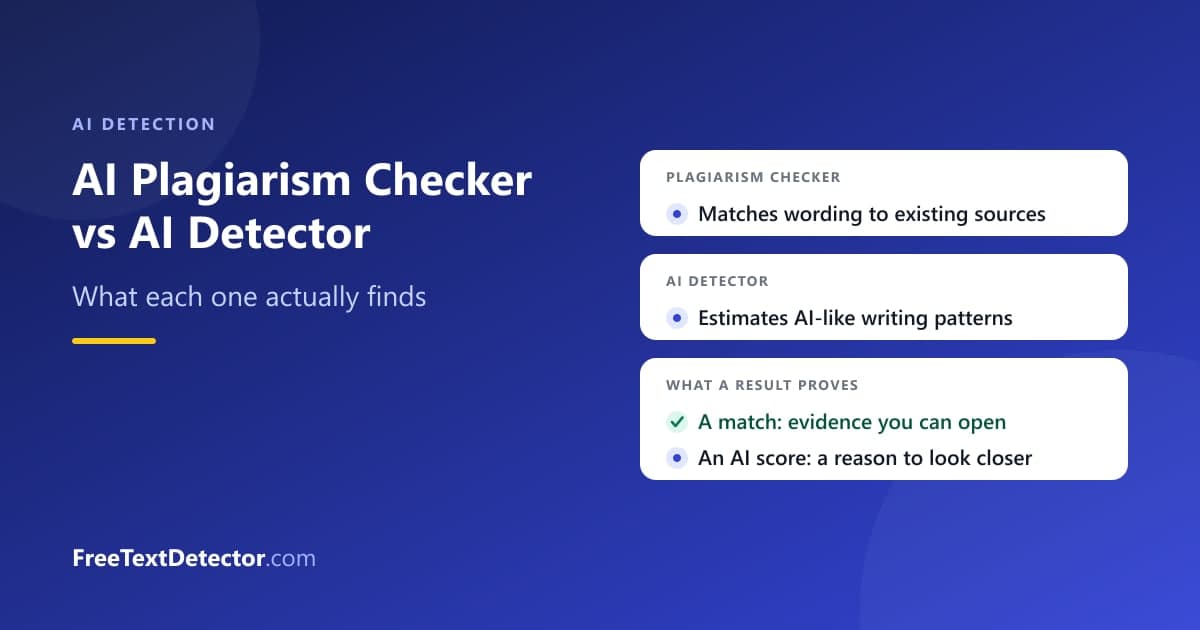
Search for an AI plagiarism checker and you will find two different tools sold under one name. A plagiarism checker compares your text against a database of existing sources and shows which passages match. An AI detector estimates whether the writing has patterns typical of language-model output, and it cannot point to a source at all. They answer different questions and miss different things. For any decision that matters, you need both checks and a person reading the work.
That split explains most of the confusion around AI plagiarism. A student sees a clean similarity report and assumes an AI-written essay is safe. A teacher sees a high AI score and assumes it proves copying. Neither conclusion follows from the tool they used.
Two tools, one search term
The two tools work in opposite directions. One looks outward at other documents. The other looks inward at the text itself.
What a plagiarism checker does
A plagiarism checker is a matching engine. It breaks your text into phrases, searches a collection of existing documents and reports the passages that line up, with the source for each one.
Turnitin is unusually blunt about this. Its guide for students says Turnitin "does not check for plagiarism". What it does is compare a submission against a database of current and archived internet content, periodicals, journals and publications, plus a repository of work other students have submitted, and then highlight wherever the writing is similar. The same guide notes that correctly quoted and referenced material will still be highlighted as a match. A human has to decide whether each match is a problem.
Grammarly's plagiarism checker page describes the same basic model: it cross-references text against more than 16 billion web pages and academic papers in ProQuest's databases, flags matching sentences, gives source references and calculates an originality score.
The output of a plagiarism checker is concrete. Here is the sentence, here is where the same wording appears, here is how much of the document overlaps.
What an AI detector does
An AI detector has no source to show you. It measures properties of the prose, such as how uniform the sentence lengths are, how predictable the word choices are and how often stock phrases appear, and turns them into a score. Our guide to how AI text detectors work goes through those signals one by one.
That score is a probability-style estimate, and the industry's own statements say so. OpenAI withdrew its AI text classifier on July 20, 2023, citing "its low rate of accuracy". In OpenAI's own evaluation it correctly labelled 26% of AI-written text as likely AI-written and wrongly labelled human text as AI-written 9% of the time. Grammarly's plagiarism checker page, cited above, says plainly that plagiarism detection and AI detection are not the same, and that AI detection tools, where they exist, are "not reliable".
Even the largest vendor keeps the two apart. According to Turnitin's Similarity product page, AI writing detection is available to Similarity customers through a separate add-on, Turnitin Originality, whose AI writing indicator sits alongside the Similarity Report rather than inside the match percentage.
AI detector vs plagiarism checker: side by side
| Plagiarism checker | AI detector | |
|---|---|---|
| Question it answers | Does this wording match text that already exists? | Does this writing have patterns common in model output? |
| What it compares against | A database of web pages, publications and past submissions | Nothing external; it measures the text itself |
| Can it name a source? | Yes, for every match | No |
| Typical output | Similarity percentage plus highlighted matches | A score or band describing writing patterns |
| Good at catching | Copy-paste, lightly edited copying, recycled submissions | Uniform, formulaic prose, whoever wrote it |
| Misses | Freshly generated AI text, sources outside its database, heavy paraphrase | Copied human writing, varied or edited AI text |
| Common false alarm | Properly quoted and cited passages, stock phrases, reference lists | Formal or technical writing by a person |
| What a result proves | That overlap exists; a person decides if it is plagiarism | Nothing on its own; it is an estimate |
The last row is the one to remember. A match is evidence you can open and inspect. An AI score is a reason to look closer.
What each check catches and misses
The gaps are predictable once you know what each tool compares against.
Fresh AI text usually slips past a plagiarism checker
A language model generates new sequences of words each time it answers. The result is usually original wording in the narrow sense a matching engine cares about, so a similarity report on a fully AI-written essay can come back low. That is the gap people are trying to close when they search for an AI plagiarism checker. A low similarity score tells you the text does not overlap much with the database. It says nothing about who or what wrote it.
Copied human writing slips past an AI detector
Run a paragraph copied from a 2015 blog post through an AI detector and it has no way of knowing. The detector sees human rhythm and human word choice, because a human wrote it. It cannot name the blog, and it may well score the passage as strongly human-like. If your worry is copying, an AI detector is the wrong instrument.
Paraphrased plagiarism is hard for both
Take someone else's argument, swap the vocabulary and reorder the clauses, and you have plagiarism of ideas with little shared wording. A plagiarism checker catches it only when enough phrasing survives. An AI detector has no view on whose idea it was. This is where a reader who knows the literature, or who asks the writer to explain the argument, does better than any tool. Our guide to ethical paraphrasing covers where the line sits and why a paraphrase still needs a citation.
AI output that reproduces a source
If a model's answer repeats wording from an existing text, such as a definition, a famous quotation or a standard description, and that text is in the checker's database, the passage shows up as a match like any other, and the writer is responsible for it exactly as if they had copied it by hand. "The AI wrote it" does not change who submitted it.
Citations that don't hold up
Neither tool checks whether a reference is real or says what the draft claims. The MLA Style Center tells writers to vet the secondary sources an AI tool cites, noting that these tools do not always cite sources and, when they do, do not always indicate precisely what a source contributed. Opening each reference is the only check that works.
Is AI content plagiarism?
Sometimes, and the answer comes from policy rather than from any tool. Two separate problems get lumped together as AI plagiarism:
- Copying without attribution. If AI output reproduces someone else's words or ideas and you present them without credit, that is plagiarism in the ordinary sense.
- Undisclosed AI use. If you submit AI-generated work as your own where the rules forbid it or require disclosure, that is misconduct even when every sentence is original wording.
Published guidance treats the second problem seriously. The APA's September 2025 guidance on citing generative AI says submitting AI-generated work as though you did it yourself "would be considered unethical", giving academic misconduct for students as an example. It adds that what AI use is allowed, and how it should be disclosed, depends on instructor, departmental and publisher policies, and that if you used AI when writing a paper it will usually be necessary to disclose the use and cite the chat or tool.
Universities write this into their rules. Stanford's generative AI policy guidance says that, absent a clear statement from the course instructor, using generative AI is treated like assistance from another person. Using it to substantially complete an assignment or exam is not permitted, and students should acknowledge use beyond the incidental and disclose when in doubt.
Research publishing lands in the same place. The Committee on Publication Ethics' position on authorship and AI tools says AI tools cannot be listed as an author, that authors must disclose in the methods (or a similar section) how an AI tool was used and which tool it was, and that authors are fully responsible for the content of their manuscript, including the parts an AI tool produced.
Citing AI use
If your context allows AI help, disclosure is what keeps it honest. The MLA page linked above advises citing a generative AI tool whenever you paraphrase, quote or incorporate content it created, and acknowledging functional uses such as editing or translating in a note or in your text. The APA guidance suggests describing how you used the tool, typically in the method section, with the AI company listed as the author of the reference. Follow whichever style your instructor or publisher requires, and check their AI policy first, because some settings prohibit AI use outright.
A workflow for checking AI plagiarism
No single score settles anything. What works is running each check for the thing it can actually see, then making a judgement with the evidence in front of you.
For teachers and editors
- Start from the rules. Know what the assignment or publication allows. A draft with AI help can be fine under one policy and a violation under another.
- Run the plagiarism check first. Open every substantial match. Discount quotations that are marked and cited, and look hard at uncredited overlap and patchwork paraphrase.
- Use an AI-pattern check as a prompt, not a verdict. A low human-like score is a reason to read that section again and perhaps ask questions. It is not evidence you can act on alone, and short or formal writing is where pattern checks go wrong most easily.
- Check the citations. Pick several references and confirm they exist and support the claims attached to them.
- Talk to the writer. Ask them to walk through the argument or show drafts, notes and version history.
For writers checking their own work
- Know your rules and disclose. If AI helped, say how, in the form your instructor, editor or client asks for.
- Check your sources against your notes. Every quotation needs quotation marks and a citation, and so does every paraphrase. If your institution gives you access to a plagiarism checker, run the draft through it and fix anything you forgot to credit.
- Read the draft for AI-like patterns. A free AI detector shows which passages are uniform or full of stock phrases. Use it as an editing aid; it does not predict what your school's tool will report.
- Verify every citation. Open each one. If an AI tool suggested it, check it twice.
- Make the draft genuinely yours. Add your own evidence, examples and judgement. Our guide to removing AI plagiarism walks through that editing process step by step, so we won't repeat it here.
The AI humanizer and paraphrasing tool can help tidy the wording of your own draft once the substance is there. They are for clarity. Using them to hide that text came from a model, or to disguise someone else's work, is still misconduct, and a rewritten passage taken from a source still needs its citation.
What FreeTextDetector checks, and what it doesn't
FreeTextDetector covers the AI-detection half of this comparison and nothing more. It has no plagiarism database and does not compare your text with web pages, publications or other submissions, so it cannot find copied passages or name sources.
The AI detector is a rule-based heuristic. It combines five signals into a human-like score from 5 to 99:
- sentence-length variety (30%)
- word predictability (20%)
- a list of 25 stock AI phrases (20%)
- contractions and conversational punctuation (15%)
- repeated sentence openers (15%)
It has not been validated against labelled human and AI text, so read the result as an estimate of writing patterns, not proof of authorship. It is free, needs no account and accepts up to 5,000 characters per check. Each signal is listed under the score, which makes it more useful for finding flat passages in your own draft than for judging anyone else's.
For source matching, use a dedicated plagiarism checker, such as the one your school or publisher provides.
Frequently asked questions
Is there one tool that checks both plagiarism and AI writing?
Some vendors offer both, but as separate reports. Turnitin, for example, sells AI writing detection as an add-on to its Similarity Report. Whatever the packaging, the two checks work differently, and a clean result on one tells you nothing about the other.
Can a plagiarism checker detect ChatGPT?
Not reliably by itself. A plagiarism checker finds wording that matches its database, and newly generated AI text usually doesn't match much. It will flag AI output only where that output repeats existing text closely enough to match.
Is using AI plagiarism?
It depends on your institution's or publisher's policy and on whether you disclose it. Presenting AI-generated work as your own where that is not allowed is treated as misconduct, and AI output that copies a source without credit is plagiarism in the usual sense. Where AI help is permitted, cite or acknowledge it as your style guide describes.
Is FreeTextDetector a free AI plagiarism checker?
No. It offers a free AI detector that estimates writing patterns, not a plagiarism checker, and it does not compare text against any database of sources, so use a dedicated plagiarism checker for that half of the job.
Should a high AI score be treated as proof of cheating?
No. AI detectors produce estimates, and OpenAI withdrew its own classifier over its low accuracy. Treat a score as a reason to look closer, then rely on matched sources, citation checks and a conversation with the writer.