
Ethical Paraphrasing: How to Rephrase Research Without Plagiarism
What separates a real paraphrase from patchwriting, the four principles that keep restatement honest, when to quote instead, and how to use rewriting tools without crossing a line.
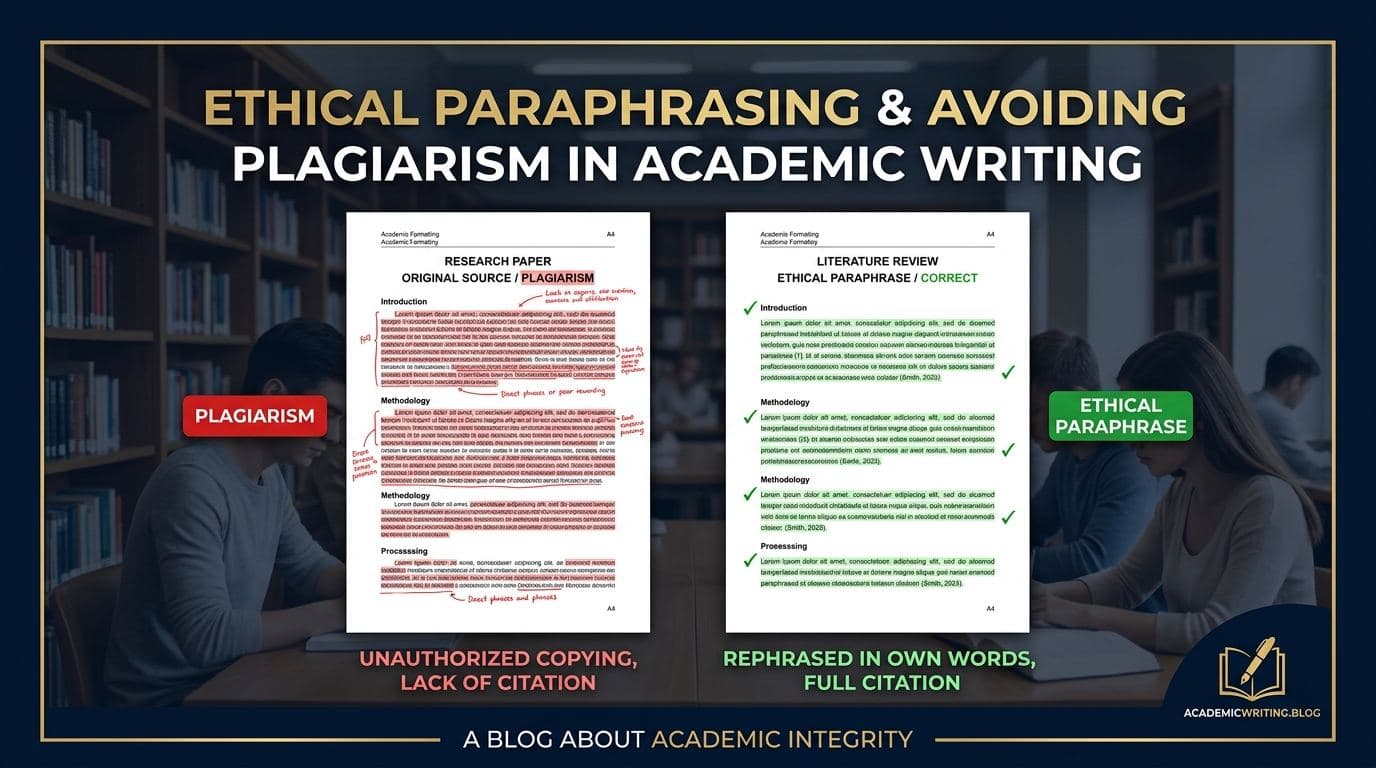
You understand a source, you want to use it, and you aren't sure how close is too close. So you swap a few words and hope.
Ethical paraphrasing means restating a source's idea in your own sentence structure and your own wording, then citing it. The failure mode has a name: patchwriting, where the words change but the original's sentence order, logic and rhythm stay in place. A citation does not repair patchwriting, because the expression is still borrowed.
Patchwriting and real paraphrasing
Most patchwriting isn't deliberate. It usually happens when a writer hasn't fully grasped the source and stays close to its wording as a safety net, which is exactly the situation in which staying close is most dangerous.
What patchwriting looks like
Original: Rapid technological transformation often destabilizes traditional labor markets before new employment opportunities fully materialize.
Patchwritten (don't do this): Swift technological change frequently disrupts conventional labor markets before fresh work options fully appear.
Look at what changed and what didn't. Individual words were substituted ("rapid" became "swift," "destabilizes" became "disrupts") and everything structural survived: the clause order, the causal logic, even the cadence. Plagiarism software matches on that structure, and an experienced marker recognises it without software.
What an ethical paraphrase looks like
Ethical paraphrase: When technology advances faster than economies can create new jobs, workers often face a period of displacement before finding stable opportunities. (Author, 2023)
This version enters the idea from a different angle, builds a different sentence around it, and attributes it. The test is not whether the words differ. It is whether you could have written this sentence without the original in front of you.
Why patchwriting is risky even when it feels safe
| Risk factor | Details |
|---|---|
| Academic penalties | Most universities classify patchwriting as academic dishonesty, even when unintentional |
| Structural matching | Plagiarism tools like Turnitin match structural similarity, not only exact strings |
| Loss of voice | Staying close to sources stops you developing your own analytical voice |
| Citation doesn't fix it | Adding a citation after patchwriting doesn't make it ethical, because the expression still mirrors the original |
| Grade consequences | Essays flagged for patchwriting often receive failing grades regardless of content quality |
Citing your source is necessary and it is not sufficient. The expression has to be genuinely yours as well.
Four principles of responsible paraphrasing
1. Understand first, write later Don't write a word of your paraphrase while the original is visible. Read the passage until you understand the idea rather than the sentence. Close the tab. Then write what you understood.
2. Restructure the logic Change the angle of entry. If the original opens on a cause, open on the effect. If it uses a list, try a compound sentence. If it is abstract, make yours concrete with an example.
3. Keep domain terminology intact Technical terms like GDP, photosynthesis, machine learning or cognitive dissonance don't need synonyms. Forcing a replacement for precise vocabulary changes the meaning rather than preserving it. Rewrite the language around the terms instead.
4. Cite every time Even a completely original restatement of someone else's idea needs attribution. The citation records where the thinking came from, and that origin is what academic integrity protects.
A repeatable process
| Step | Action | Why it helps |
|---|---|---|
| 1 | Read the passage twice | Ensures genuine comprehension |
| 2 | Set the source aside | Forces you to work from memory, not word by word |
| 3 | Write your version freely | Natural language, not translation |
| 4 | Compare with the original | Catches unintended structural copies |
| 5 | Fix any close matches | Restructure sentences that mirror the source |
| 6 | Add the citation | Attributes the original idea properly |
Step 4 is where most drafts fail, and it is the step people rush. Our companion guide on paraphrasing without changing meaning works through the mechanics of that comparison in detail, including what must never change between the source and your version.
When to quote instead of paraphrase
Sometimes a paraphrase is the wrong tool. Four situations call for the source's exact words, and recognising them saves you from a paraphrase that is either dishonest or pointless.
Quote verbatim when the wording itself is the evidence. If you are analysing how a politician phrased a promise, a paraphrase destroys the thing you are arguing about. Quote when the phrasing is a term of art that a restatement would blur, such as a statutory definition or a clause from a contract. Quote when the original is more precise than any restatement you can write, which is common with legal and technical sources. And quote when the author's authority is part of your point, because "the World Health Organization defines X as…" carries weight that your summary of the same sentence does not.
Outside those four cases, paraphrase. A quotation that only restates a plain fact wastes your reader's attention and hands your word count to somebody else.
How to quote
Short quotations of a phrase or a single sentence go inline, inside quotation marks, with the citation immediately after. Longer passages go in a block quote, indented, without quotation marks, again with the citation. Either way, three rules hold:
- Never change a word inside the quotation marks. Use square brackets for any alteration you must make for grammar, and an ellipsis for anything you cut.
- Introduce the quote in your own sentence so the reader knows why it is there before they read it.
- Follow it with your own comment. A quotation dropped between two paragraphs with no framing is a gap in your argument, not support for it.
Here is the decision in practice. Suppose your source says: "The 2019 amendment narrowed the definition of 'employee' to exclude workers engaged through intermediaries." If your essay is about how that definition changed, quote it, because the exact wording of the exclusion is the point. If your essay is about the amendment's effects on gig workers, paraphrase: The 2019 amendment removed intermediary-engaged workers from the statutory definition of employee (Author, 2019), which left a large share of the gig workforce outside the protections that follow from it. Same source, different jobs, different treatment.
Using AI paraphrasing tools ethically
The paraphrasing tool and essay rewriter can legitimately help you restate a passage. What matters is how you use them, and the line falls in a consistent place: a tool may help you express an idea you already understand, and it may not stand in for understanding it.
Ethical use:
- Take suggestions as a starting point, then edit until the sentence is yours
- Check that the meaning survived the rewrite before you keep it
- Add your citation after any rewriting pass, exactly as you would otherwise
Unethical use:
- Pasting tool output straight into a submission unread
- Using a machine paraphrase to cover material you don't understand
- Submitting rewritten text with the attribution dropped
One more limit is worth naming. Running a passage through any rewriter does not make its content yours, and no tool output is evidence that a paraphrase is ethical. That judgement is yours, and it rests on whether you understood the source and credited it. If your worry is that a draft contains borrowed structure you can no longer see, removing AI plagiarism covers how to find and fix it.
Frequently asked questions
What's the difference between paraphrasing and summarizing?
Paraphrasing restates specific ideas in your own words at roughly the same length. Summarizing condenses a whole section or source into its main points, much shorter. Both require citation.
If I cite my source, is any paraphrase acceptable?
No. A citation records where an idea came from; it says nothing about how you expressed it. Patchwriting with a citation attached is still an integrity violation at most institutions.
How do I know if my paraphrase is too close?
Read your version and the original side by side and look at structure rather than words: clause order, sentence count, where the emphasis falls. You can also run both through the AI paraphraser, which reports semantic similarity, and aim for preserved meaning with low textual overlap.
Can I paraphrase something I don't fully understand?
Not ethically, and not successfully. Without comprehension you will either distort the claim or stay so close to the wording that it becomes patchwriting. Read more, ask, then write.
Is it acceptable to paraphrase one source repeatedly?
Yes, provided each restatement is genuinely yours and each is cited. Heavy reliance on a single source does suggest you haven't read widely enough, which is a separate criticism a marker may still make.
Does this apply outside academia?
Yes. Journalism, content writing and business writing all have plagiarism standards, and many publications screen submissions before accepting them. The principles don't change with the setting.
The habit that prevents all of this
Close the source before you write. Almost every patchwriting case starts with the original visible on screen, and almost none survives the discipline of working from your own notes instead. The trade-off is real, since writing from memory feels slower and less precise at first, and the paraphrases it produces need less repair later.