
How to Improve Readability: A Practical Guide With Score Tables and Fixes
Learn what readability means, how it's measured, what Flesch scores to target for your content type, and practical techniques to make your writing easier to read.
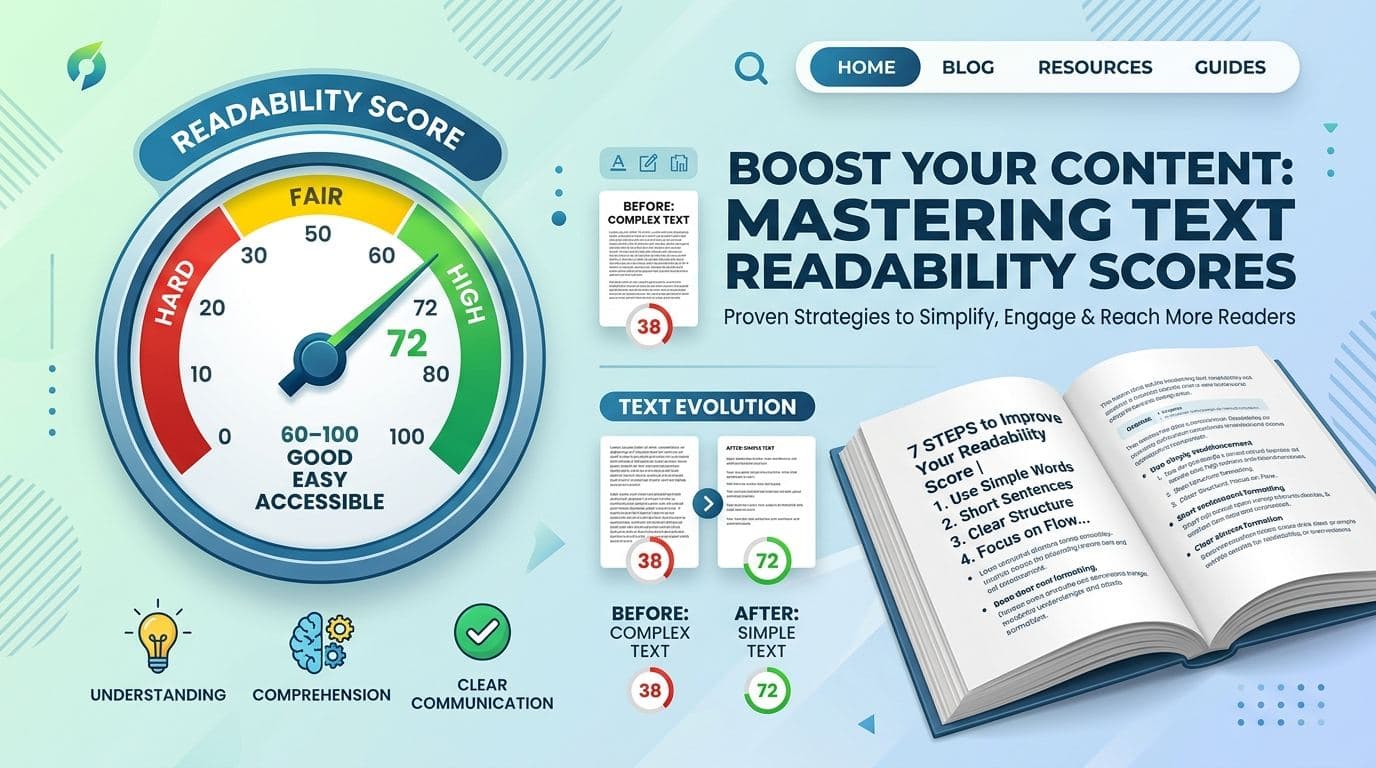
You can research a topic thoroughly, organise it well, and still lose readers in the first thirty seconds. Readability is the usual culprit.
Readability is a measure of how much effort a reader spends decoding your text rather than understanding it. It is driven mainly by sentence length and word complexity, which is what the standard formulas count. The fastest improvement is usually cutting the longest quarter of your sentences in half.
What readability actually measures
Readability is invisible when it is good and impossible to ignore when it is bad. The factors behind it overlap, which is why fixing one in isolation rarely helps much:
- Sentence length. Long sentences make the reader hold more in working memory before the meaning resolves.
- Word complexity. Common words are recognised faster than rare ones, whether or not the reader knows the rare one.
- Syllable count. Fewer syllables per word means faster processing, which is why the formulas count them.
- Sentence variety. A monotonous rhythm tires readers even when every individual sentence is short.
- Visual structure. Headings, lists and white space give the eye somewhere to rest and something to scan.
Those factors interact rather than add up. A page of short sentences with no headings is still a wall. A page with excellent headings and sixty-word sentences underneath them is still hard to follow. The formulas only see two of the five, which is the main reason a good score is not the same thing as a readable page.
How readability is measured
Several formulas are in common use, and Flesch Reading Ease is the one most tools report by default. It runs from 0 to 100, and higher means easier.
| Score range | Difficulty | Typical audience |
|---|---|---|
| 90–100 | Very easy | Around 11 years old |
| 80–89 | Easy | Lower secondary |
| 70–79 | Fairly easy | Upper secondary |
| 60–69 | Standard, plain English | General adult audience |
| 50–59 | Fairly difficult | Late secondary |
| 30–49 | Difficult | Undergraduate |
| 0–29 | Very confusing | Graduate or specialist |
Most web content and blog writing sits comfortably at 60 to 70. Marketing copy often aims a band higher. Academic journals sit at 30 to 50, and that is appropriate for their readers rather than a failure.
The formula behind that table, the grade-level conversion, and the per-content-type targets are covered in detail in our guide to Flesch-Kincaid reading ease. What matters here is what you do with the number. Use the readability checker to get a baseline before you start editing, then re-check once, at the end. Chasing the number section by section produces choppy prose.
The five problems that cost you the most
1. Sentences that run too long
Over about 25 words, a reader has to hold several clauses open at once before the sentence resolves. Some readers will do it. Most will reread the sentence, and a few will stop.
Before:
The researchers, who had been studying the phenomenon for over a decade, decided to publish their findings, which had been peer-reviewed by three independent groups, in the most prestigious journal in their field.
After:
The researchers had studied the phenomenon for over a decade. After peer review by three independent groups, they published their findings in a leading journal.
A working target is an average of 15 to 20 words, with real variation around it. An average of 17 achieved by writing every sentence at exactly 17 words is worse than the problem it solves; our guide to sentence structure covers how to vary length deliberately.
2. Complex words where simple ones work
Rare and technical vocabulary creates friction even for readers who know the words, because recognition speed tracks frequency rather than education.
| Complex | Simple |
|---|---|
| utilize | use |
| ameliorate | improve |
| facilitate | help |
| commence | begin |
| terminate | end |
| subsequent | next |
| endeavor | try |
Use the longer word when precision genuinely requires it. "Terminate" and "end" are not synonyms in a contract. They are in a blog post.
3. Dense, unbroken paragraphs
A wall of text tells the reader, before they have read a word of it, that this will take effort. Many of them will not start.
Keep paragraphs to three or four sentences in most cases. Add a subheading every 200 to 300 words. Move anything that is really a list out of the paragraph and into a list, where the parallel structure does the explaining for you.
4. No visual anchors
Text with no structure is measurably harder to work through, not merely less attractive. A reader who cannot see where a section begins has no way to skim, and skimming is how most people decide whether to read.
The tools that help are unglamorous: H2 and H3 subheadings, bold on key terms, bullet lists for parallel items, tables for genuine comparisons, block quotes for examples you want isolated. Use each one where it fits and nowhere else. A page where everything is bold has nothing emphasised.
5. Buried verbs and missing actors
Nominalizations and passive constructions both add words without adding information, and both push the score toward "difficult": "the implementation of the solution was achieved" instead of "we implemented the solution." Each conversion shortens the sentence and names the person responsible, which helps the reader twice.
Both habits have their own guides, because both have legitimate uses worth understanding before you edit them out: fixing nominalizations and choosing between active and passive voice.
A quick checklist
- Are most sentences under 25 words, with real variation between them?
- Have the complex words that were not doing precise work been simplified?
- Are paragraphs three to five sentences at most?
- Is there a subheading at least every 250 words?
- Has passive voice been reduced where the actor matters?
- Are there lists, tables or headings breaking up the page?
Frequently asked questions
What readability score should a blog post have?
For a general audience, 65 to 75 on Flesch Reading Ease is a sensible band: accessible without reading as though it were written for children. Adjust it to who you are actually writing for rather than to the number.
Does readability affect SEO?
Not as a ranking factor. Google has not published readability, sentence length or word count as ranking signals, and claims that it has are speculation dressed up as fact. The honest case for readable prose is simpler: readable prose is easier for a person to finish.
Can I improve readability without losing depth?
Yes, and the clearest writers in most technical fields are also the most authoritative ones. Clarity is usually evidence that the writer understands the material well enough to choose what to leave out. What you cannot do is simplify the ideas and call it a readability edit.
Should every piece target the same score?
No. A graduate research paper and a product page have different readers with different tolerance for effort. Match the target to the audience, and accept that a specialist document scoring 40 may be exactly right.
How do I check my readability score for free?
The readability checker reports Flesch Reading Ease, Flesch-Kincaid Grade Level and the Gunning Fog Index on any text you paste in.
Will better readability increase conversions?
We publish no figures on this and would be inventing them if we did. What can be said without a study is that a reader who has to work to understand an offer is less likely to finish reading it.
Where to start
Sort your draft by sentence length and fix the top ten. That single pass moves the score more than every other technique on this page combined, and it takes about ten minutes on a 1,500-word article. The failure mode to watch for is the opposite of the original problem: once every sentence is short, the prose goes flat, and flat is its own kind of unreadable.