
How to Fix Nominalizations: Kill the Zombie Nouns in Your Writing
Learn what zombie nouns (nominalizations) are, why they make your writing feel heavy and passive, and how to spot and fix them with practical before/after examples.
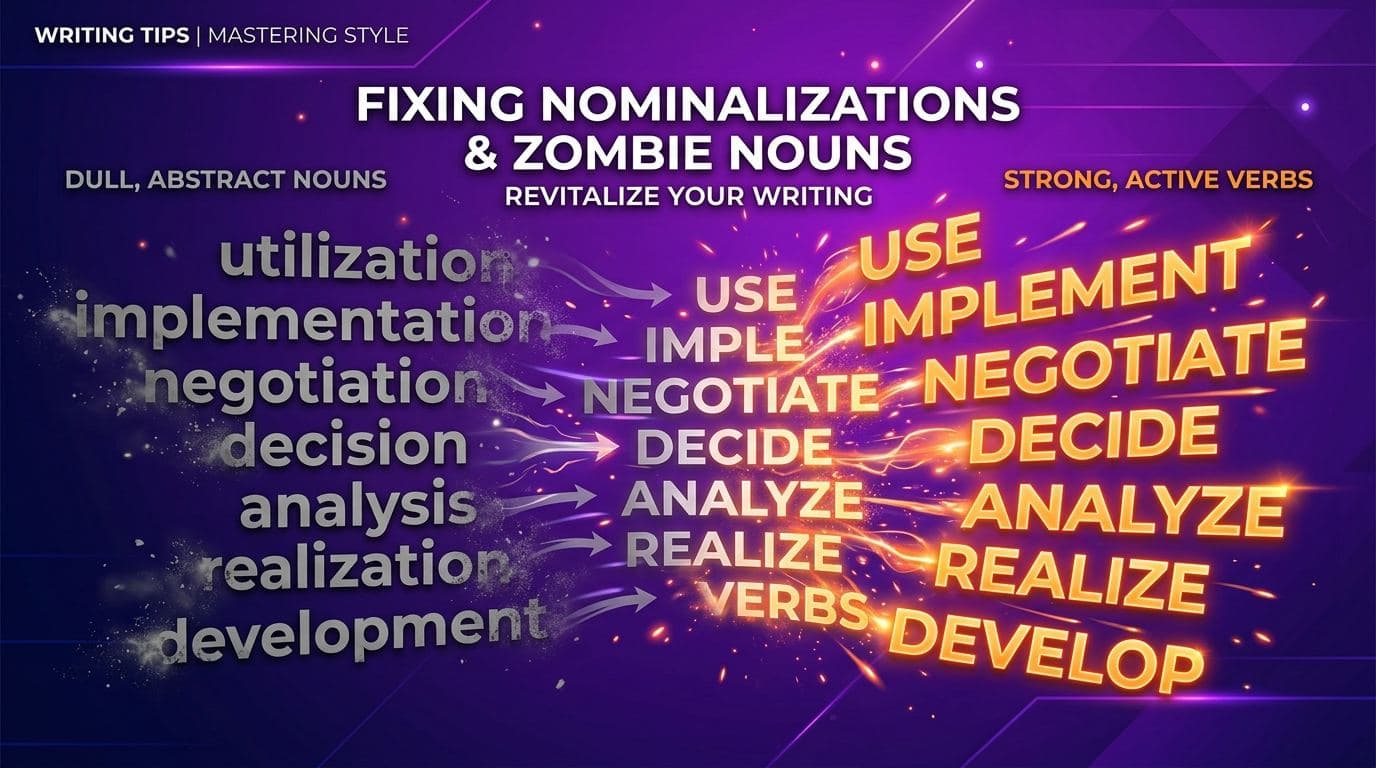
Some sentences are technically correct and still exhausting to read. Usually the reason is that their verbs have been turned into nouns.
A nominalization is a noun made from a verb or adjective, like "analysis" from "analyze" or "flexibility" from "flexible." The fix is two steps: find the verb buried inside the noun, then rebuild the sentence with that verb as its main verb and a real actor as its subject.
Linguist Helen Sword coined the term "zombie nouns" for what academics call nominalizations — words that started life as vivid verbs or adjectives and got converted into abstract nouns. When this happens, the real action of a sentence gets buried, and your writing pays the price.
What exactly is a nominalization?
You can usually spot one by its suffix.
| Suffix | Verb → nominalization | Example sentence |
|---|---|---|
| -tion / -sion | analyze → analysis | The analysis of the data was conducted. |
| -ment | develop → development | The development of the plan took weeks. |
| -ence / -ance | perform → performance | The performance of the system improved. |
| -ity | flexible → flexibility | There is a need for flexibility. |
| -ing (as noun) | meet → meeting | The holding of a meeting was proposed. |
None of these words is wrong in isolation, and the last column is not a list of errors. The problem is density. When nominalizations crowd out the working verbs in a paragraph, every sentence needs a helper verb ("was conducted," "took," "is") to carry the grammar, and those helpers are the flattest words in English.
The classic example
Here is the kind of sentence that fills corporate documents:
Nominalized: The committee came to the conclusion that a reduction in expenditure was necessary for the achievement of organizational sustainability.
That is 24 words. Now with the verbs restored:
Action restored: The committee concluded that the organization must reduce spending to stay sustainable.
That is 14 words, a cut of roughly 42 percent, and not one idea was dropped. Three things changed:
- "came to the conclusion" became "concluded," one verb doing the work of four words
- "a reduction in expenditure was necessary" became "must reduce spending"
- "achievement of organizational sustainability" became "stay sustainable"
Common patterns you can fix today
| Zombie noun version | Active alternative |
|---|---|
| make an assumption | assume |
| conduct an investigation | investigate |
| reach an agreement | agree |
| provide an explanation | explain |
| give consideration to | consider |
| undertake an assessment | assess |
| effectuate an improvement | improve |
| make a decision | decide |
| carry out an analysis | analyze |
| be in possession of | have |
| make reference to | refer to |
| take into consideration | consider |
Every row has the same shape: a weak general verb ("make," "conduct," "give," "take") plus an abstract noun that used to be the real verb. Once you see the pattern, you stop needing the list. Nominalizations are one of several habits that add length without adding meaning, and our guide to making writing more concise covers the rest of the family.
How to de-nominalize your own writing
Step 1. Scan for suffix markers. Search the draft for words ending in -tion, -ment, -ance, -ence and -ity. Those are your suspects, not your convictions.
Step 2. Find the buried verb. Ask what the action is. Every real nominalization has a verb inside it: "investigation" hides "investigate," "development" hides "develop."
Step 3. Find the real actor. Ask who is doing it. Often the actor is missing entirely, or shoved into a trailing "by" phrase. Pull them to the front.
Step 4. Rewrite with the verb as the main verb. Make the actor the subject, use the recovered verb as the sentence's main verb, and delete the prepositions that were propping up the noun.
Step 5. Prune what is left. Words like "of," "by" and "in relation to" tend to vanish on their own once a strong verb is carrying the sentence. They only existed to support the zombie noun.
If you would rather see the pattern flagged than hunt for it manually, the text improver marks nominalization structures and suggests the verb form.
Why this overlaps with passive voice
The two habits travel together. A passive construction removes the actor from the subject position, and a nominalization removes the verb from the verb position, so a sentence with both has no one doing anything: "the implementation of the solution was achieved." Fix either half and the other usually becomes obvious, which is why it is worth reading the guide to active and passive voice alongside this one.
When nominalizations are doing real work
Not every nominalization needs to die. Three cases earn their keep.
Continuity between sentences. "The analysis revealed three patterns. That analysis built on earlier work." Using the noun here lets the second sentence point back at the first without repeating it, which is a genuine cohesion device.
Established technical terms. If "implementation" is the concept under discussion rather than a rephrased verb, it is a term of art and should stay a noun.
Abstract subjects. Philosophy, economics and law discuss concepts as things. "Freedom," "justice" and "inflation" are all nominalizations, and all three are the actual subject of sentences that could not be written any other way.
Legal and policy writing, where the nouns are load-bearing
Plain-language advocates often treat legal drafting as the worst offender, and in the prose around a clause they are usually right. Inside the clause itself the picture is different, because a nominalization can be the defined term that the whole document turns on.
Consider a contract sentence that genuinely needs its noun:
"Termination" means the ending of this Agreement under clause 12, whether by notice or by expiry.
You cannot verb that. "Termination" is the thing being defined, and every later reference depends on it being a noun with a fixed meaning. Rewriting it as "to terminate means to end" breaks the cross-references and the definition alike.
Now consider the prose that surrounds such a clause, where the same habit is pure padding:
Nominalized: Notification of termination shall be effected by the Supplier through the provision of written notice to the Customer prior to the expiration of the notice period.
Action restored: To terminate, the Supplier must give the Customer written notice before the notice period expires.
The second version is 15 words against 26, and it is more precise rather than less: it names who must act, which the original left to inference. The rule for this register is narrow. Keep the nominalization when it is a defined term or a term of art, and convert it everywhere it is merely describing a step someone has to take.
Frequently asked questions
Why are nominalizations so common in business and academic writing?
Because they sound formal, and formality gets mistaken for authority. The irony is that direct writing is more persuasive and much easier to act on, which is what a business document is for.
Are all words ending in -tion nominalizations?
No. "Nation," "station" and "fiction" have no verb hiding inside them. The test is whether you can name the verb the word was derived from; if you cannot, it is just a noun.
Can I remove all nominalizations from my writing?
You would not want to. Some have no verb form in ordinary use ("information," "organization"), and some carry precision you would lose. The target is the unnecessary ones that replaced a perfectly good verb.
How do I check whether my writing has too many?
Run a section through the sentence rewriter and compare the suggestions to your original. Both tools detect the suffix-plus-weak-verb pattern, which is the bulk of the problem in practice.
Does fixing nominalizations help SEO?
Not directly, and nobody should tell you otherwise. Readability is not a published Google ranking factor. Recovering the verbs makes a page easier for a person to finish, which is the reason to do it.
What is the fastest way to practise spotting them?
Take a paragraph from a corporate report or an academic paper and try to cut it by 30 percent without losing any meaning. The nominalizations are where the 30 percent comes from, and after two or three paragraphs you will see them without looking.
What to do first
Search your draft for the four weak verbs rather than the suffixes: "make," "conduct," "give," "take." They sit in front of almost every avoidable nominalization, and there are far fewer of them to scan for than there are nouns ending in -tion. The trade-off to watch is overcorrection, since a document with no abstract nouns at all cannot state a general rule, and legal and policy writing needs to.