
How to Detect AI-Generated Text: A Practical Five-Step Method
How to detect AI-generated text step by step: manual signs to read for, fact and citation checks, a free AI detector as one signal, and a talk with the writer.
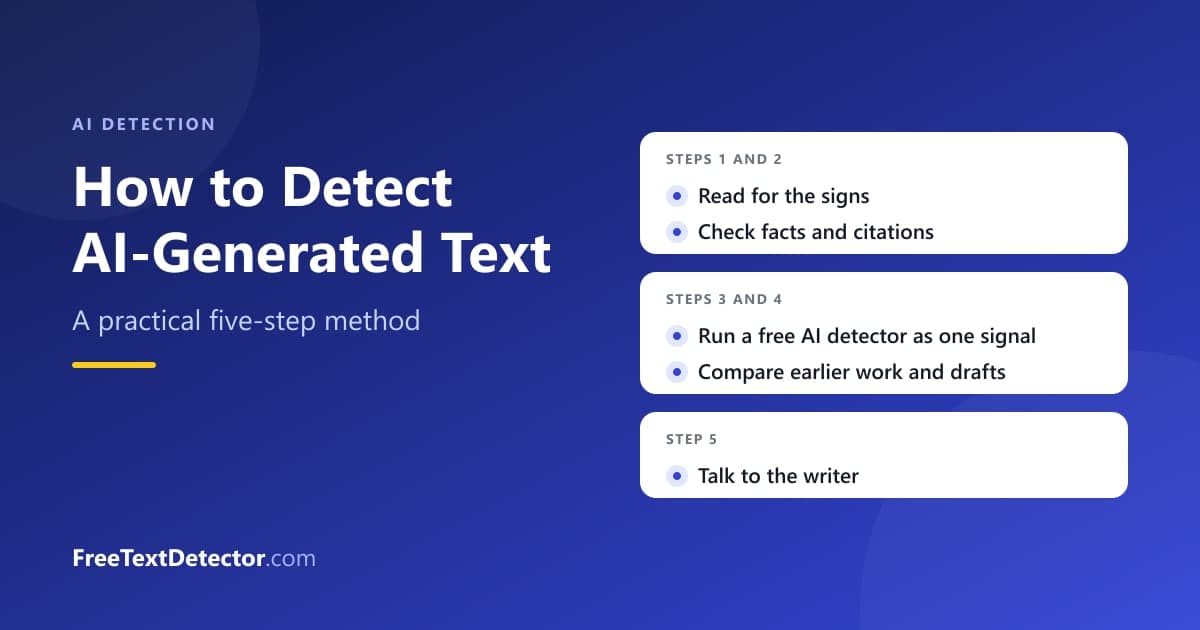
Here is how to detect AI-generated text in practice: read the piece for the manual signs first, check every fact and citation, run a free AI detector as one extra signal, compare the text with the writer's earlier work and drafts, and then talk to the writer. Do all five. No single sign and no single tool proves who wrote something, and the people who get this wrong are usually the ones who stopped after step three.
This guide is for the person holding the document: a teacher, an editor, a client who paid for original copy. It is a human-led process, and software is only one part of it.
Step 1: Read for the signs of AI writing
Start with your own eyes, before any tool colours your judgement. Read the whole piece once at normal speed and note where your attention slides off the page. Then go back and look for the specific habits below.
Each one is a reason to look closer. None is a verdict, because every habit on this list also shows up in rushed, nervous or heavily templated human writing.
Uniform sentence rhythm
Count the words in five consecutive sentences. Raw model output tends to keep them close to one length, with the same shape repeated: a clause, a comma, another clause.
AI-sounding example: "Remote work offers many benefits for employees and employers. It allows workers to save time on their daily commute. It also gives companies access to a wider pool of talent. Many organizations have adopted flexible policies as a result."
Every sentence is tidy and about the same length. Compare a person writing from experience:
Human-sounding example: "I got back ninety minutes a day when my team went remote. That's it. That's the whole case, for me, though our hiring manager would add that we can now interview people outside commuting distance of Leeds."
The second is more convincing because the rhythm follows the thought: one long sentence, one tiny one, then a longer one again.
Stock transitions and phrases
Models lean on a small set of connecting phrases. One means nothing; a cluster is worth marking.
AI-sounding example: "Moreover, time management plays a crucial role in academic success. Furthermore, it is important to note that in today's fast-paced world, students face many distractions. In conclusion, developing good habits is essential."
Four stock phrases in three sentences, and not one concrete claim. Circle these when you see them, then ask what the sentence would say without them. Often the answer is nothing.
Generic claims with no specifics
The text makes claims that are true of every example of the topic and therefore say little about this one.
Before (generic): "The novel explores themes of identity and belonging, using vivid imagery to convey the protagonist's emotional journey."
After (specific): "In chapter two the narrator stops answering her mother's calls, and the author spends a full page on the phone ringing in an empty kitchen, not on the argument that caused it."
The first sentence could describe hundreds of novels. The second could only describe one book. When a book report, product review or case study never names a page, a price, a person, a date or a place, ask why.
Confident errors and invented citations
Language models write fluently whether or not the facts underneath are real. The result is a wrong date, a misattributed quote or a journal article that does not exist, stated in the same calm tone as everything else. An unsure human tends to hedge or leave the detail out. A model tends to fill the gap. Step 2 covers how to check.
Both-sides endings that hedge
Models often decline to take a position. Their essays end with a paragraph that weighs "both sides" and concludes that the answer "depends on individual circumstances".
AI-sounding example: "Ultimately, whether social media is harmful depends on how it is used. While it has drawbacks, it also offers significant benefits, and a balanced approach is key."
If the assignment asked for an argument and the conclusion refuses to make one, note it. Plenty of students hedge on their own, though.
Repeated sentence openers
Read only the first two words of each sentence down a page. Model text often starts sentence after sentence the same way: "This approach…", "This method…", "This means…", or a run of "It is…".
Missing first-hand detail
Ask what in the text only this writer could have supplied. A reflection with no named moment, a lab report with no mention of what went wrong at the bench, a client blog post about "our team" that never names a customer or a number. Missing first-hand detail is the strongest of the reading signs, because it is the one a model cannot fake without being told the facts.
The signs at a glance
| Sign | What it looks like | How much weight to give it |
|---|---|---|
| Uniform sentence rhythm | Sentences of similar length and shape, paragraph after paragraph | Low on its own; formal and non-native writing is often regular |
| Stock transitions | The connecting phrases from the example above, stacked at sentence starts | Low for one or two; moderate when they cluster |
| Generic claims | Statements true of any example of the topic; no names, numbers or places | Moderate |
| Confident errors | Wrong facts stated calmly, quotes that cannot be traced | High, once you have confirmed the error |
| Invented citations | References to articles, cases or books that do not exist | High, once you have searched properly |
| Hedged both-sides ending | A conclusion that refuses to conclude | Low |
| Repeated openers | "This…", "It is…" starting sentence after sentence | Low to moderate |
| Missing first-hand detail | Nothing only this writer could know | Moderate to high, depending on the task |
The high-weight signs are about content, not style. Style tells you where to look; content is what holds up when you have to explain your concern to someone else.
Step 2: Check the facts and citations
This step takes the longest and produces the firmest evidence. Pick the three most specific claims in the piece and verify them, then check every citation in the reference list.
For each reference, search the exact title in quotation marks, then search the journal or publisher's own site. Check that the authors exist and work in that field, that the year matches, and that the article says what the text claims it says.
Invented references are not a hypothetical risk. In Mata v. Avianca, a federal judge in the Southern District of New York imposed a $5,000 sanction in June 2023 after lawyers filed a brief citing cases that ChatGPT had made up.
One caution: people mangle page numbers and misremember titles. What you are looking for is several references that do not exist at all, each with plausible authors, journals and years.
Step 3: Run a free AI detector as one signal
Now bring in software, and give it limited weight. OpenAI launched its own classifier for AI-written text and then withdrew it. Its announcement page now says that "as of July 20, 2023, the AI classifier is no longer available due to its low rate of accuracy". The same OpenAI page reported that, on its challenge set, the classifier correctly labelled 26% of AI-written text as likely AI-written and wrongly labelled human-written text as AI-written 9% of the time. Treat every other tool's number with the same caution.
If you want to understand what these tools compute, such as perplexity and burstiness, our guide to how AI text detectors work covers the internals.
What FreeTextDetector's detector measures
The AI detector on FreeTextDetector is a rule-based heuristic, not a trained classifier. It combines five signals into a human-like score from 5 to 99:
- Sentence-length variety (30%): how much sentence lengths vary across the passage
- Word predictability (20%): how spread out word choice is, measured against a word-frequency list
- Stock AI phrases (20%): how many of 25 phrases that AI drafts overuse appear, and how densely
- Contractions and conversational punctuation (15%): "don't", "it's", questions and the like
- Repeated sentence openers (15%): how often sentences start the same way
It has not been validated on labelled human and AI text, so its output is an estimate of writing patterns, not proof of anything. It is free, needs no account, and takes up to 5,000 characters per check.
How to read the result
Ignore the headline number at first and read the list of signals under it. That list is the useful part: it shows which stock phrases were found, whether sentence lengths are uniform and whether openers repeat.
Then compare the list with your notes from step 1. If it flags low sentence variety in a piece written in formal academic register, that may simply describe the genre.
Do not run the text through five detectors and take a vote. Tools built on overlapping signals share blind spots, so their agreement is weaker evidence than it looks.
Step 4: Compare with earlier work and version history
A writer's past work is the best baseline you have. Put the new piece next to two or three earlier ones written in similar conditions. Look at vocabulary, habitual mistakes, paragraph length and use of the first person. A sudden jump in polish is worth noting, as is the disappearance of an error that shows up in every earlier essay. But people improve, get tutoring or use a grammar checker. A change is a question, not an answer.
Version history is often more telling than the text itself. Google Docs keeps a version history of every document, and Word lets you go back to previous versions of files stored in OneDrive or SharePoint. A document built over several sessions, with deletions, rewrites and comments, looks very different from one that appeared as a single large paste ten minutes before the deadline. Ask for notes, outlines or earlier drafts too. A writer who did the work can usually produce some trace of it.
Step 5: Talk to the writer
This is the step people skip, and it often settles the question. Keep the conversation about the work, not the accusation.
Ask them to walk you through how they wrote it. Ask why they chose a particular source and what it argued. Ask them to explain a claim from the middle of the piece in their own words. Someone who wrote the text can usually talk about it at length, including the parts they struggled with.
Nervous people give poor answers, and a writer who used AI for an outline and then wrote every sentence may be following your rules exactly. Check the policy that actually applies (the syllabus, the contract, the style guide) before you decide what counts as a breach.
How to detect AI-generated text without accusing the wrong person
Some writers are at much greater risk of a false accusation. A 2023 study by Liang and colleagues, published in the journal Patterns (preprint on arXiv), ran 91 TOEFL essays written by non-native English speakers through seven GPT detectors. The average false positive rate was 61.22%, and 89 of the 91 essays (97.80%) were flagged as AI-generated by at least one detector. For essays by US eighth-graders, the average was 5.19%.
Writers with a constrained vocabulary, writers following a strict template and writers of formal technical prose all show the low-variety patterns that detectors and human readers associate with models. A few habits keep the process fair:
- Write down what you saw before you run any tool. It stops the score from shaping what you notice.
- Weigh content evidence above style evidence. A fabricated source outweighs any number of stock phrases.
- Never act on a detector score alone. Not ours, not anyone's.
- Look for agreement across independent steps. Fake citations, no drafts and a writer who cannot explain the argument add up. One of those alone does not.
- Record your reasoning. If you escalate, you should be able to show the specific problems, not a percentage.
Frequently asked questions
How can you tell if text is AI generated?
Look for several signs together: uniform sentence rhythm, clusters of stock transitions, generic claims, missing first-hand detail and, most tellingly, facts or citations that turn out to be false. Then check drafts and earlier work, and ask the writer about the piece.
Can a free AI detector prove that someone used AI?
No. A detector measures writing patterns, and those patterns also appear in human writing, especially formal prose and writing by non-native English speakers. The FreeTextDetector score is an estimate, and it lists the signals behind it so you can judge them yourself.
What is the most reliable sign of AI writing?
Fabricated facts and invented citations, once you have confirmed they do not exist. They are content evidence, and you can show them to someone else. Asking the writer to explain the work is the other strong check.
What should I do if my own writing gets flagged?
Gather evidence of your process: version history, notes, outlines and earlier drafts. Offer to talk through how you wrote the piece. If the flagged signals point to genuinely flat prose, editing for varied sentences and specific detail, by hand or with an AI humanizer used as a clarity editor, makes it better for readers.
How long does a text need to be to check it?
A few paragraphs is enough to read for patterns. Detectors need more, because sentence variety and phrase density cannot be measured well in a handful of sentences. Several hundred words give a steadier reading, though still not proof.