
10 Common Grammar Mistakes That Hurt Your Professional Image (With Fixes)
Spot and fix the 10 most common grammar mistakes in professional writing, from dangling modifiers to comma splices, with clear examples, tables and a full FAQ.
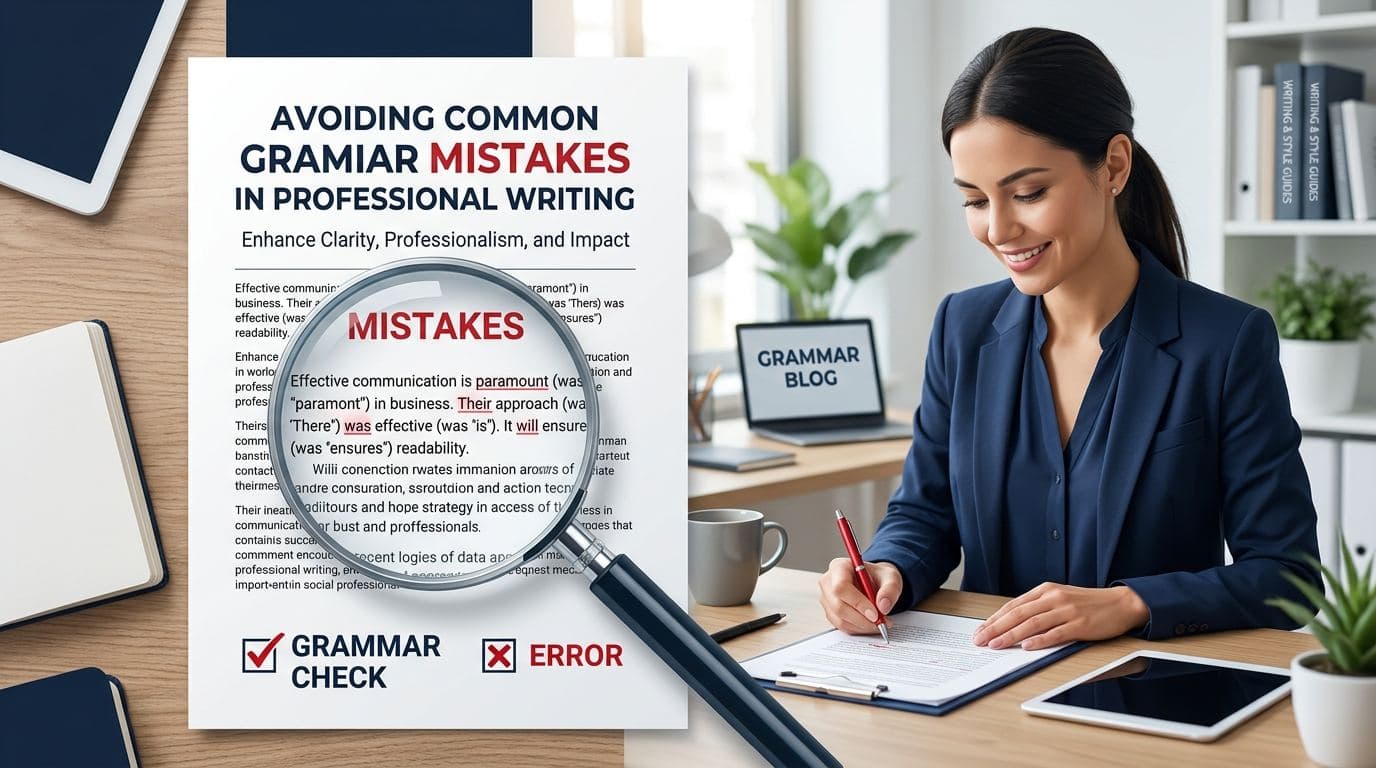
One misplaced comma in a contract. Small errors carry outsized weight in professional writing, and readers notice them even when they cannot name the rule you broke.
The ten grammar mistakes below all cost you credibility, but three do the most damage in professional writing: dangling modifiers, comma splices and subject-verb disagreement. Each one makes a reader stop and reconstruct your meaning, and a reader who has to work that hard starts doubting the rest of the document.
1. Dangling modifiers
A dangling modifier is a descriptive phrase that does not attach to the thing it is meant to describe. The result is usually accidentally funny, which is worse than being merely unclear.
❌ Incorrect: Walking into the boardroom, the financial report shocked the CEO. (This says the report was walking into the boardroom.)
✅ Correct: Walking into the boardroom, the CEO was shocked by the financial report.
The fix: make sure the noun immediately after the opening phrase is the thing performing the action in that phrase.
2. Comma splices
A comma splice joins two complete sentences with nothing but a comma: no conjunction, no semicolon.
❌ Incorrect: The rollout was delayed, we will launch next Tuesday.
✅ Options:
- The rollout was delayed; we will launch next Tuesday. (semicolon)
- The rollout was delayed, so we will launch next Tuesday. (conjunction)
- The rollout was delayed. We will launch next Tuesday. (separate sentences)
This is the most common of the ten in email, because we write email the way we talk and speech does not have punctuation. Slow down when you proofread.
3. Subject-verb agreement across an intervening phrase
Writers match the verb to the nearest noun instead of to the actual grammatical subject. It happens most often when a long modifier sits between the two.
❌ Incorrect: The list of deliverables, timelines, and milestones are ready.
✅ Correct: The list of deliverables, timelines, and milestones is ready.
The subject is "list," which is singular. Everything from "of" to "milestones" is a modifier.
Trick: strip out everything between the subject and the verb and read what is left. "The list… are ready" sounds wrong immediately.
4. It's versus its
This one catches native speakers daily, and it catches them in headlines and slide decks as readily as in drafts.
| Word | What it means | Example |
|---|---|---|
| It's | It is, or it has | It's a great opportunity. |
| Its | Belonging to it | The company lost its biggest client. |
The fix: substitute "it is." If the sentence still works, use the apostrophe. If it does not, use "its."
5. Affect versus effect
- Affect is almost always a verb, meaning to influence something
- Effect is almost always a noun, meaning the result of something
❌ High interest rates effect consumer spending. ✅ High interest rates affect consumer spending.
❌ The new policy had a major affect on employee morale. ✅ The new policy had a major effect on employee morale.
There are exceptions. "Effect" works as a verb meaning to bring about (they effected change), and "affect" is a noun in psychology. Neither exception is likely to come up in a status report, so the verb-noun rule will carry you.
Quick reference for all ten
| Mistake | Wrong | Right |
|---|---|---|
| Dangling modifier | "Running late, the meeting was canceled." | "Running late, we canceled the meeting." |
| Comma splice | "I finished early, let's leave." | "I finished early, so let's leave." |
| Subject-verb | "The team of managers are here." | "The team of managers is here." |
| It's vs its | "The app lost it's data." | "The app lost its data." |
| Affect vs effect | "This effects everything." | "This affects everything." |
| Faulty parallelism | "We aim to grow, retain, and cost reduction." | "We aim to grow, retain, and reduce costs." |
| Pronoun ambiguity | "When John met Mark, he was nervous." | "When John met Mark, John was nervous." |
| Less vs fewer | "Less employees attended." | "Fewer employees attended." |
The first five are mostly rules you either know or do not. The remaining five are judgement calls, which is why they survive proofreading more often.
6. Faulty parallelism
Parallel ideas in a list or a compound structure have to share a grammatical form.
❌ Our goals are increasing revenue, reducing churn, and to expand into new markets.
✅ Our goals are increasing revenue, reducing churn, and expanding into new markets.
Pick one form when you start the list, whether that is an -ing verb, an infinitive or a plain noun, and hold it to the end. Parallelism problems cluster around passive constructions, because a passive clause changes the shape of the verb; the guide to active and passive voice covers why.
7. Run-on sentences
A run-on fuses two or more independent clauses with no punctuation and no conjunction at all. A comma splice at least has the comma.
❌ The report was submitted on time the client approved it immediately the team celebrated.
Fix it with periods, with semicolons, with coordinating conjunctions, or by breaking the whole thing into separate thoughts. If your drafts run long, our guide to improving sentence structure covers the length-variance habits that prevent them.
8. Ambiguous pronoun reference
Every pronoun needs exactly one noun it could plausibly refer to. When two candidates are available, the reader picks one, and half the time they pick the wrong one.
❌ When the server crashed during the demo, it was a disaster. (Was the server a disaster, or the demo?)
✅ The server crash ruined our client demo.
Notice that the fix here was not to clarify the pronoun but to delete it. That is often the shortest route, and it is the same move described in making writing more concise.
9. Less versus fewer
- Fewer for things you can count: fewer meetings, fewer errors, fewer employees
- Less for things you cannot: less time, less confusion, less money
❌ We had less complaints this quarter. ✅ We had fewer complaints this quarter.
Complaints are countable, so "fewer" it is.
10. Tense inconsistency
Jumping between past and present inside a single narrative leaves the reader unsure what has already happened.
❌ The team analyzed the data, and then the manager presents the findings to the board.
✅ The team analyzed the data, and then the manager presented the findings to the board.
Choose a tense per logical unit and commit to it. Past tense suits a case study or an incident report. Present tense suits a how-to. Mixing them inside one section is the error; switching deliberately between sections is not.
Proofreading for all ten in one pass
Ten rules is too many to hold in your head while reading, so do it mechanically instead.
Read the draft aloud first, at normal speaking speed. Your ear catches comma splices, run-ons and tense jumps without needing to name them, because all three break the rhythm of speech. Then do a second pass reading sentence by sentence from the end of the document backwards; that breaks the narrative flow and forces you to evaluate each sentence on its own, which is where dangling modifiers and orphaned pronouns show up. Finally run the text through the grammar checker to catch the mechanical items, agreement and apostrophes, that a tired reader skips.
Three passes sounds like a lot. It takes about five minutes on a two-page document, and it is the difference between a draft that is nearly right and one you can send.
Frequently asked questions
Are grammar mistakes really that serious in professional settings?
They cost you credibility, which is difficult to get back. A reader who spots an obvious error in a proposal starts wondering what else was not checked, and that doubt attaches to your numbers as readily as to your prose.
Does spell-check catch grammar mistakes?
Not most of them. Spell-check finds misspelled words. It will not flag "affect" used as a noun, a dangling modifier or a pronoun with two possible referents, because every word in those sentences is spelled correctly.
What is the best way to proofread for grammar?
Read aloud, then read backwards sentence by sentence. The two passes catch different categories of error, which is why doing both beats doing either twice.
Can grammar rules be broken on purpose?
Yes. Sentence fragments for emphasis and sentences opening with "And" or "But" are stylistic choices, not errors, and they are house style in plenty of good publications. The condition is that you know the rule you are breaking and why.
Which mistake shows up most in professional email?
Comma splices. Email gets written at speaking speed, and at speaking speed a comma feels like enough of a pause to join two thoughts. It is not.