
Best AI Detector for Students: What to Look For and What It Can't Prove
How to pick the best AI detector for students checking their own essays, why your school's result may differ, and what to do if you're wrongly accused.
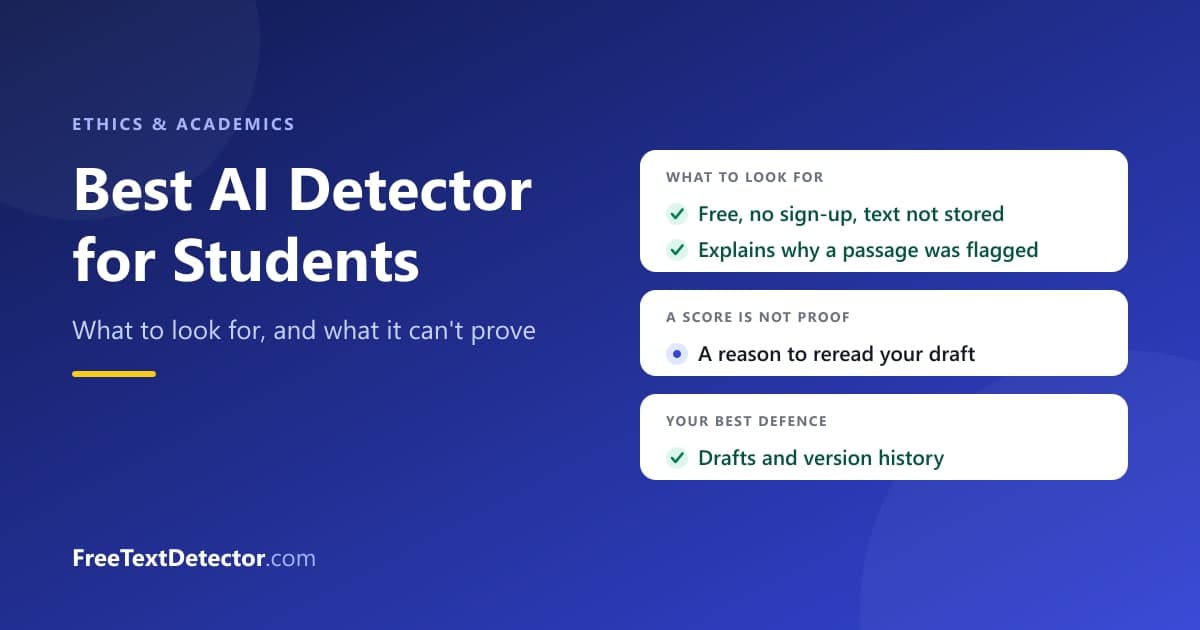
Looking for the best AI detector for students? Pick the one that fits the job you actually have: checking your own essay before you hand it in. That means a free AI detector that needs no sign-up, doesn't keep your text, shows you why a passage was flagged and copes with essay-length work. "Best" here is about fit, not accuracy. No free tool can tell you what your school's detector will say, and none of them can prove who wrote a paragraph. Treat any score as a reason to reread your draft, never as a verdict.
What the best AI detector for students should do
Most "best detector" lists rank tools by an accuracy figure. Be wary of those. An accuracy number means something only when you know the labelled text it was measured on, how much of it there was, and who ran the test. Most lists give you none of that.
So this post uses a different yardstick. A student checking their own work has four needs that have nothing to do with a leaderboard:
- You shouldn't have to pay or hand over an email address to check a draft.
- Your essay shouldn't end up stored on someone else's server.
- You need to know which sentences drew the flag and why, or the score gives you nothing to act on.
- The tool has to take an essay's length, or tell you plainly how to split it.
A tool that meets all four is a good fit for a student. It still can't tell you your work is "safe", because nothing can.
A checklist for choosing an AI checker for essays
| What to check | Why it matters to a student | What a good answer looks like |
|---|---|---|
| Free to use | You may check several drafts of every assignment | No paywall on the basic check |
| No sign-up | Fewer places holding your details | Paste, check, done |
| Text not stored | Unsubmitted coursework is yours | A clear statement in the FAQ or privacy policy |
| Explains the result | A bare percentage gives you nothing to fix | Named signals or highlighted passages |
| Handles essay length | Essays are long and limits vary | A stated character or word limit |
| Honest about limits | Overconfident tools cause panic | Calls its score an estimate, not proof |
The last row matters most. A tool that presents its score as a verdict is misleading you, however polished it looks.
Why your school's detector may disagree with any free tool
Many schools run submissions through Turnitin, which institutions switch on for their own courses. According to Turnitin's FAQ on its AI writing detection, the AI writing indicator and report "are not visible to students", although instructors can download the report and share it. In practice, you usually can't run the check your marker will see.
Even if you could, detectors don't agree with each other. They're built differently and tuned on different text. Turnitin's FAQ describes splitting a submission into overlapping segments and scoring each one with a trained model. FreeTextDetector doesn't use a trained model at all. Expect different numbers for the same essay, and don't read a good result on one site as a forecast of another.
What Turnitin says about its own error rates
These are the vendor's own claims, not independent findings. In the same FAQ, Turnitin says it aims to keep its document-level false positive rate under 1% for documents with over 20% AI writing, which it explains as possibly flagging one in every 100 fully human-written documents. In a post on sentence-level false positives, it puts the sentence-level rate at around 4% and says those errors are more common in documents that mix human and AI writing, especially near the transitions. The FAQ also says scores below 20% are shown only as an asterisk, to avoid false positives in that range, and that an English submission needs at least 300 words of prose to get a report.
Then there's the sentence every student should know. Turnitin's FAQ says the percentage "should not be used as the sole basis for action or a definitive grading measure by instructors." If you're ever accused on the strength of a score alone, quote it.
One in 100 sounds small. Across a large course and a semester of essays, it isn't, and the student it lands on doesn't experience it as 1%.
False positives and who they hit hardest
The best-known study is Liang et al., "GPT detectors are biased against non-native English writers", published in Patterns in 2023. The researchers ran seven GPT detectors over 91 TOEFL essays written by non-native English speakers and 88 essays by US eighth-graders. On the US essays the detectors were close to accurate, with an average false positive rate of about 5%. On the TOEFL essays, the full paper reports an average false positive rate of 61%, and all seven detectors agreed on flagging 18 of the 91 as AI-written. People wrote every one of those essays.
The authors trace this to word choice: the non-native writers showed more limited linguistic variability, which produces lower-perplexity text, the very thing detectors read as machine-like. They also note a caveat. Most detectors they tested were built on GPT-2, and results may differ for detectors built on newer models. The mechanism is still worth understanding, because any detector that rewards surprising word choice will be harder on students writing carefully in a second language.
The same logic puts other students at risk:
- Writers following a strict template, such as a lab report or a set paragraph structure
- Students taught to write formally and avoid contractions
- Very short answers, where there isn't enough text to measure variety
- Anyone whose grammar tool has evened out their sentences
None of this means you did anything wrong. It means the tool is measuring style, and your style overlaps with what it looks for.
Where FreeTextDetector fits
The AI detector on this site meets the four needs above, and it has limits you should know before you use it.
How it works. It's a rule-based heuristic, not a trained model. It combines five signals: sentence-length variety (30%), word predictability (20%), the density of 25 stock AI phrases (20%), contractions and conversational punctuation (15%), and repeated sentence openers (15%). The result is a human-like score from 5 to 99, with the signals behind it listed underneath, so you can see what moved the number.
What it offers. It's free, you don't need an account, your text isn't stored after the result comes back, and each check takes up to 5,000 characters. That's roughly 800 words of typical essay prose, so a longer essay needs two or three checks, section by section.
What it doesn't do. The method hasn't been validated against a labelled set of human and AI text. The score is an estimate of writing patterns, not proof of authorship, and it won't match Turnitin's number. Don't use it to predict your school's result. Use it to find passages where your writing has gone flat or formulaic, then decide whether they need work.
If the signals point at long, tangled sentences rather than rhythm, the readability checker or the grammar checker will usually help more. Our guide to how AI text detectors work explains each signal in more depth.
How to protect yourself before you submit
The strongest defence against a false AI detection accusation isn't a score from another website. It's evidence that you did the work.
Keep your drafts and version history
Write somewhere that records history. Google Docs lets you browse and restore earlier versions of a file, and Word keeps a version history for files saved to OneDrive or SharePoint. A document that grew over several sessions, with rough early paragraphs and later fixes, is hard to argue with. One big paste of finished text is much weaker evidence, even if you wrote it elsewhere first. If you draft on paper or in another app, keep those files too.
Keep notes and sources
Save your reading notes, outlines, annotated PDFs and the sources you actually used. If someone asks you to explain your argument, showing where each idea came from and talking it through is persuasive in a way no detector report is. Our guide to ethical paraphrasing covers using sources in your own words, so your notes and your essay line up.
Write in your own voice
Your normal voice, with the examples you'd reach for and the way you'd make a point out loud, is better writing and harder to mistake for a template. Mix short and long sentences. Cut stock transitions. Add details only you have: the case study from your seminar, the numbers from your own lab session.
Follow your course's AI policy
Policies vary a lot. Some courses ban generative AI outright, some allow it for brainstorming or grammar, and some require you to say how you used it. Read the policy for each course, not just the university's general statement. Where AI use is allowed, disclose or cite it in the format your instructor asks for. Permitted, disclosed use isn't misconduct. Hidden use can be, even when a note would have made it acceptable.
When an AI humanizer is and isn't appropriate
This site also has an AI humanizer, so here's where the line sits for students.
Using it on your own draft to improve clarity is fine, as long as your course allows editing tools. Swapping stock phrases for plain wording, splitting overloaded sentences, making vague passives active: that's the same kind of help a grammar checker or a writing centre gives.
Using it to disguise work you didn't write is academic misconduct. Running AI-generated text or someone else's essay through a rewriter doesn't make it yours. You'd still be submitting work that isn't your own as if it were. No tool should be used to hide where writing came from, and ours makes no promise about any detector's result. What AI text humanization is goes further into that distinction.
What to do if you are wrongly accused
A false accusation is frightening, but it's usually a process with steps, not a single decision. Work through it calmly.
- Stay calm and don't admit to something you didn't do. Ask for the concern in writing, including the evidence it rests on.
- Ask what the detector reported and how it's being used. If the case rests on a score alone, point to your institution's policy and, where Turnitin was used, to its own statement that the percentage shouldn't be the sole basis for action.
- Read your institution's academic integrity procedure. Find out your rights, the deadlines, and whether someone can come with you to a meeting.
- Gather your evidence. Version history, drafts, notes, outlines, sources, and any emails with tutors about the assignment.
- Offer to talk through the work. Explaining your argument, sources and choices in person is often the most convincing evidence there is.
- Get support early. Most universities have a students' union advice service or an academic advocate.
- Keep it factual. Write short, polite, specific replies, and save a copy of everything.
Don't lean on a screenshot from a free detector as your defence. A second tool's good score proves nothing, for the same reason a bad score proves nothing. Your process evidence is what carries weight.
Frequently asked questions
What is the best AI detector for students?
The best fit is a tool that's free, needs no sign-up, doesn't store your essay, explains why a passage was flagged and handles essay length. That's a judgement about fit, not accuracy. No detector is reliable enough to prove authorship, and no free tool can predict what your school's detector will report.
Can I check my essay with Turnitin before submitting?
Usually not. Turnitin's FAQ says the AI writing indicator and report aren't visible to students, although instructors can download and share the report. Ask your instructor whether your course offers any draft check.
Why did a free AI detector give a different score from my school's?
Because they work differently. FreeTextDetector scores five rule-based signals, while Turnitin describes using a trained model. Different methods on the same text produce different numbers, and neither result proves who wrote it.
Can a human-written essay be flagged as AI?
Yes. Turnitin says its document-level false positive rate is under 1% for documents with over 20% AI writing, which is not zero, and the 2023 Liang et al. study found seven detectors misclassified, on average, 61% of essays by non-native English writers as AI-generated. Keep drafts and version history so you can show how your work developed.
Is it cheating to use an AI humanizer on my essay?
It depends on what you're rewriting and on your course's policy. Editing your own draft for clarity, where editing tools are allowed, is similar to using a grammar checker. Using a rewriter to disguise text you didn't write is academic misconduct.