
Best Free AI Text Detectors 2026: An Honest Buyer's Guide
The best free AI text detectors of 2026 compared on free limits, sign-up, highlighting, languages, privacy and the accuracy evidence behind each one.
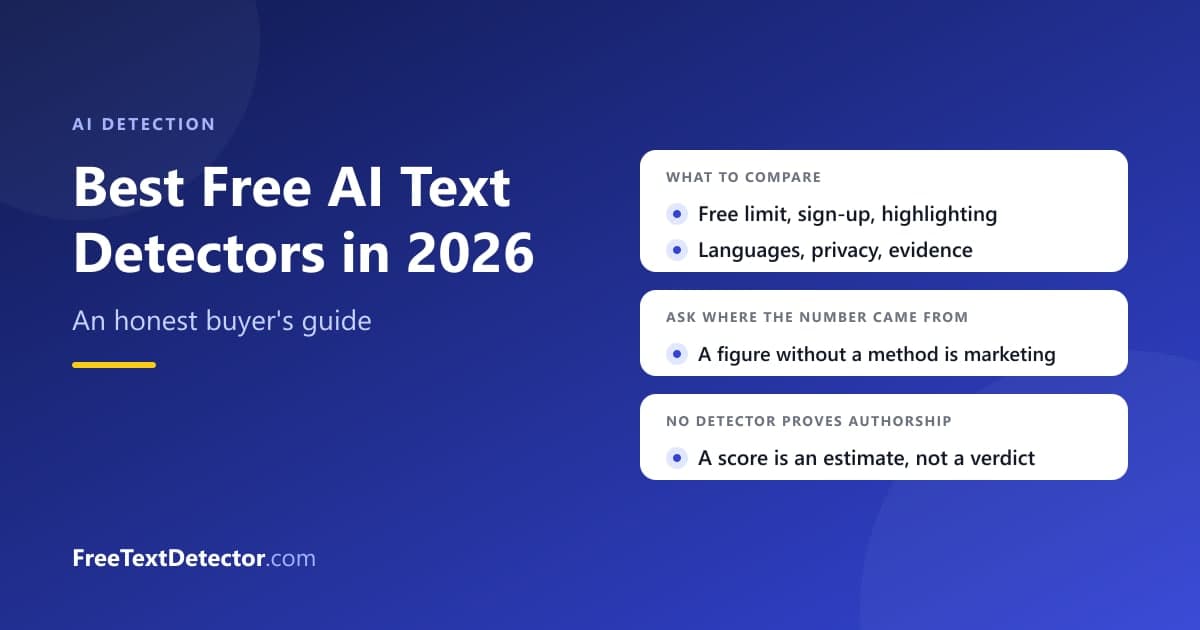
The best free AI text detectors of 2026 are GPTZero, Copyleaks, ZeroGPT, QuillBot, Scribbr, the free tier of Originality.ai and our own pattern check at FreeTextDetector. Turnitin is on most shortlists too, but only institutions can buy it. There is no single winner. Pick the tool whose free limit fits your text, that works without an account if you care about that, and that shows you why it flagged a passage. None of them can prove who wrote something.
How this guide was put together
We have not run our own accuracy test on these tools, so this guide contains no accuracy ranking. Every limit, price and feature below comes from the vendor's own website or help centre as of September 2026, and each one is linked. Vendors change free tiers often. If a number matters to you, check the linked page before you rely on it.
Vendor accuracy figures are labelled as the vendor's own claims. Independent research gets its own section.
What to compare in a free AI detector
Most "top 10" lists compare tools on which one catches the most AI text, the one thing nobody outside the vendors has measured well for current models. The things you can check yourself matter more.
Free limit per check, and per day or month
A free tier can be generous per check and stingy per day, or the reverse. Look at both numbers. A 1,200-word cap is fine for a cover letter and useless for a dissertation chapter. Watch the minimums too: short texts give unstable scores anyway.
Whether you need an account
Some tools scan straight away. Others give a score without an account but hide the detail behind a free sign-up. If you are checking something confidential, an account also means your scans may be kept in a history.
Whether it explains the score
A bare percentage tells you almost nothing you can act on. The more useful tools show which sentences drove the result, or which signals. Look for sentence-level highlighting at minimum, and ideally some reason attached to each flag.
Languages
Most detectors were built for English first. If you write in Spanish, German or Japanese, check the vendor's list of supported languages instead of assuming.
Privacy and data retention
Read what happens to your text. Some vendors say they don't store it. Others say text pasted into the free tool may be used for training. That difference matters for unpublished work, client drafts and student essays.
Published accuracy evidence
Every vendor says it is accurate. Ask where the number came from: the vendor's own test set, or a published study you can read. A figure without a method is marketing.
Best free AI text detectors 2026 compared
This table covers the free versions only. "Not stated" means we could not find the fact on the vendor's official pages.
| Tool | Free limit (as of September 2026) | Account for free use | Shows where or why | Languages (vendor's list) |
|---|---|---|---|---|
| GPTZero | 10,000 characters per scan; free plan covers up to 10,000 words a month | Not needed up to 10,000 characters | Highlights phrases it flags | English, German, Portuguese, French, Spanish |
| Copyleaks | 25,000 characters per scan | Not needed for a score; free account unlocks sentence-level detail | Sentence insights with free account; "AI Logic" explanations on paid plans | 30+ |
| ZeroGPT | 15,000 characters in the homepage checker | Not stated | Highlights sentences | "All languages" (vendor's claim) |
| QuillBot | 1,200 words per scan, 6 scans a day, 80-word minimum | Not needed under 1,200 words | Sentence-level highlights | 20+ |
| Scribbr | 1,200 words per submission, unlimited checks | Not needed | Paragraph-level feedback | English, Spanish, German, French |
| Originality.ai (Basic) | 2,000 words per scan, 3 scans a day, 100-word minimum | Not needed for the 3 daily scans | Not stated for the free tier | 30 |
| Turnitin | Not sold to individuals | Institution account | Highlights segments, visible to instructors | Long-form English, Spanish, Japanese, Modern Arabic |
| FreeTextDetector | 5,000 characters per check, no daily credit limit | Not needed | Lists every signal behind the score | English |
Tool-by-tool notes
GPTZero
GPTZero's checker on its homepage takes up to 10,000 characters, and the page says to create a free account for longer scans. Its pricing page describes a free plan that covers up to 10,000 words a month. Results highlight the specific phrases the model flagged. The homepage advertises "99% Accuracy", which is the vendor's own figure. Its FAQ is also blunt about limits: "No AI detector is 100% accurate," and results "should not be used to punish or as the final verdict." GPTZero says it is SOC 2 Type II compliant and deletes personal data on request.
Copyleaks
Copyleaks' AI detector page says you can scan up to 25,000 characters without logging in. The score is free; full sentence-by-sentence insights and highlighted phrases need a free account. Its "AI Logic" feature, which shows why text was flagged, sits in the paid plans. The vendor claims over 99% accuracy and a 0.03% false positive rate, and lists support for over 30 languages. On its pricing page, the Personal plan costs $16.99 a month, or $13.99 a month billed annually, for 100 credits (one credit covers up to 250 words).
ZeroGPT
ZeroGPT's homepage checker accepts up to 15,000 characters and highlights the sentences it attributes to AI, with a gauge for the overall percentage. The homepage claims 98.4% detection accuracy and a false positive rate under 1%. Those are the vendor's numbers, and we could not find a published study behind them on the page. It also says it supports "all the languages," so test your own language before trusting that.
QuillBot AI Detector
QuillBot's AI detector is free up to 1,200 words per scan and six scans a day, with an 80-word minimum. QuillBot's own blog post says scans under 1,200 words need no sign-up and no credit card. It reports separate figures for AI-generated and AI-refined text and highlights sentences. QuillBot says it supports 20+ languages and claims a 99% detection rate "according to independent evaluations from RAID." RAID is a real, public academic benchmark, covered below, but the 99% summary is QuillBot's wording. Its page also says results "are probability estimates, not verdicts."
Scribbr AI Detector
Scribbr's detector allows unlimited free checks of up to 1,200 words each, with no account. It distinguishes AI-generated, AI-refined and human-written text and gives paragraph-level feedback. Supported languages are English, Spanish, German and French. On privacy, the page says "we do not store or share your data." Scribbr also states that its free version detects GPT-2, GPT-3 and GPT-3.5 text "with average accuracy," while detecting GPT-4 is a Premium feature. That's a candid line worth weighing if you mostly see text from current models.
Originality.ai
Originality.ai is built for publishers and is mainly a paid tool. Its pricing page lists a free Basic tier: AI detection only, 3 scans a day, 2,000 words per scan. The AI checker FAQ confirms the free scans don't need an account and sets a 100-word minimum. Read the privacy line before you paste anything: text entered in the free detector "may be used for training," and only account holders can opt out. Paid Pro costs $14.95 a month, or $12.95 a month billed annually, for 2,000 credits at 100 words each. The vendor calls its tool the most accurate in third-party studies; that is its claim, not ours.
Turnitin (institutions only)
You can't sign up for Turnitin as an individual. Its help centre says it does not sell individual licenses and sells only to schools, universities and organisations. According to its AI detection FAQ, the indicator covers long-form English, Spanish, Japanese and Modern Arabic, and only instructors and administrators can see it. Turnitin aims to keep its false positive rate under 1% for documents with over 20% AI writing, and it says the percentage "should not be used as the sole basis for action." If a student is worried about a Turnitin result, no free tool will reproduce it.
FreeTextDetector's pattern check
Our free AI detector works differently from every tool above. It is not a trained classifier. It is a set of rules that combine five signals into a human-like score from 5 to 99:
- Sentence-length variety (30%)
- Word predictability, from a word-frequency list (20%)
- Density of 25 stock AI phrases (20%)
- Contractions and conversational punctuation (15%)
- Repeated sentence openers (15%)
It has not been validated on labelled human and AI text. The score is an estimate of writing patterns, not proof of authorship, and formal human writing can score as AI-like. What it does offer: it is free, needs no account, takes 5,000 characters per check, lists every signal behind the number, and doesn't store your text after returning the result. Because its phrase list is English, treat it as an English-only tool. If you want the detail on how scores like this are built, our guide to how AI text detectors work covers it.
What independent research says
Vendor figures come from vendor test sets. Independent studies tell a less comfortable story, and they are the reason no detector result should decide anything alone.
- A 2023 study of 14 tools in the International Journal for Educational Integrity (Weber-Wulff et al.) found that none scored above 80% accuracy and concluded the tools were "neither accurate nor reliable."
- A Stanford study (Liang et al., 2023) ran seven detectors on 91 TOEFL essays written by non-native English speakers. They misclassified over half as AI-generated, with an average false positive rate of 61.22%.
- OpenAI withdrew its own classifier in July 2023 "due to its low rate of accuracy." Before that, it had reported that the tool labelled human text as AI-written 9% of the time on its challenge set (OpenAI).
- RAID (Dugan et al., ACL 2024) is a public benchmark of over 6 million generations across 11 models and 11 adversarial attacks. The authors released the data along with a leaderboard, which makes it the most useful place to look if you want evidence you can inspect yourself.
The pattern across all four is the same. Detectors do better on plain, unedited model output and worse on edited text, short text and non-native writing. False positives happen, including on text a person wrote from scratch.
How to choose
Match the tool to the job rather than to a leaderboard.
- Checking your own essay before you submit it. Scribbr and QuillBot both take 1,200 words without an account.
- Screening long documents. Copyleaks takes 25,000 characters without logging in, and GPTZero takes 10,000.
- Editing for readability. Use a tool that tells you why. Our free AI detector lists the exact signals, so you can see that the issue is, say, twelve sentences of the same length or four stock phrases in one paragraph.
- Confidential text. Pick a tool that states it doesn't store submissions, and avoid pasting client or student work into any tool whose free tier may use it for training.
- Non-English text. Check the vendor's supported list first. Copyleaks and Originality.ai list around 30 languages; Scribbr lists four.
Running the same text through two or three tools is reasonable. Expect them to disagree; that is normal.
What to do with a high AI score
Treat it as a note about your prose, not a verdict on you. Scores tend to jump when sentences all run the same length, stock transitions pile up and nothing is specific. Those are writing problems, and fixing them improves a draft whatever any detector says.
You can fix them by hand, or use our AI humanizer as a first pass: it swaps stock phrases for plain wording and splits long, uniform sentences, then shows the before and after side by side. It is an editing aid, not a way around anyone's policy, and it can't promise any particular score. Our guide on how to humanize AI content walks through the manual edits.
If someone else flagged your work, a counter-score from another detector proves nothing. Drafts, notes and version history are what show how a text was written.
Frequently asked questions
Which free AI text detector is the most accurate?
No published, independent study we know of ranks the current free versions of these tools against each other, so we don't name one. Vendors publish their own accuracy figures, but those come from their own test sets. The RAID benchmark's public leaderboard is the closest thing to a neutral comparison you can check yourself.
Can any AI detector prove that a person used AI?
No. Every tool here returns an estimate, and independent studies have found false positives on human writing, especially from non-native English writers. Turnitin, GPTZero and QuillBot all say on their own pages that results shouldn't be treated as a final verdict.
Which free AI detectors work without signing up?
As of September 2026, GPTZero (up to 10,000 characters), Copyleaks (up to 25,000 characters for a basic score), QuillBot (under 1,200 words), Scribbr (1,200 words), Originality.ai (3 scans a day) and our own detector (5,000 characters) all let you scan without an account. Some reserve sentence-level detail for signed-in users.
Why do two AI detectors give different scores for the same text?
They are trained or built on different data and measure different things. One may weigh word predictability heavily while another leans on sentence rhythm. Disagreement is the normal case, which is why no single score should decide anything.
Is FreeTextDetector's AI detector free?
Yes. It is free, needs no account and accepts up to 5,000 characters per check, with only a fair-use rate limit. It is a rule-based pattern estimate that hasn't been validated on labelled data, so use it to find stiff passages to revise, not to judge who wrote a text.